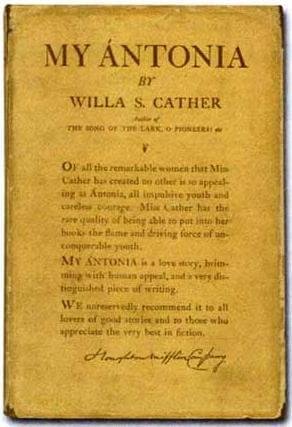
My Antonia — Summary & Analysis
by Willa Cather
Overview
My Ántonia (1918) is widely regarded as Willa Cather's first masterpiece and the crowning achievement of her Great Plains trilogy, which also includes O Pioneers! (1913) and The Song of the Lark (1915). Set on the Nebraska prairie during the late nineteenth century, the novel chronicles the lives of immigrant settlers arriving on the American frontier. At its center is Ántonia Shimerda, the spirited eldest daughter of a Bohemian immigrant family, and Jim Burden, the Virginia orphan who befriends her — and who narrates the novel decades later from memory.
Plot Summary
The novel opens with a framing device: an unnamed author encounters Jim Burden, now a successful New York attorney, on a train. Both grew up in Nebraska and knew Ántonia. Jim later delivers a manuscript — his memories of her — which forms the body of the novel.
Jim arrives in Black Hawk, Nebraska as a ten-year-old to live with his grandparents. On the same train are the Shimerdas, a Bohemian family who have crossed the Atlantic in search of a new life. Mr. Shimerda, a cultivated musician and gentle soul, is utterly unprepared for the brutal demands of frontier farming. The Shimerdas are settled into a barely livable dugout on the open prairie, and the family struggles deeply through their first winter. When homesickness and despair become too great, Mr. Shimerda dies by suicide, leaving the family — particularly Ántonia — devastated but resolute.
Jim and Ántonia form a close friendship across the social and cultural divide. He tutors her in English; she teaches him about the land. As Jim's grandparents later move into town so he can attend school, Ántonia is hired out as a domestic servant for the prosperous Harling family. She becomes part of the group of lively "hired girls" — immigrant daughters who work in Black Hawk's households and are admired by the young men of the town, though looked down upon by "respectable" society.
Jim goes off to university in Lincoln, then to Harvard Law School. Ántonia, meanwhile, is seduced and abandoned by a man named Larry Donovan, left with an illegitimate child, and returns home to her family's farm. Rather than breaking her, these hardships seem to deepen her vitality. Book IV reveals that she has married a Czech immigrant named Anton Cuzak and has built a teeming household full of children, warmth, and the smell of earth and harvest.
Twenty years after leaving Nebraska, Jim visits Ántonia at last. He finds her aged and weathered but unmistakably the same woman: alive, generous, rooted in the land. The novel ends not with romantic resolution but with something richer — a recognition of enduring friendship and the mythic force of the pioneer spirit.
Major Themes
Memory and nostalgia anchor the novel's structure. Jim narrates everything in retrospect, and the novel asks what we carry forward from the places and people that shaped us. The Nebraska prairie is not mere setting — it functions almost as a character itself, vast and indifferent, capable of crushing people (as it does Mr. Shimerda) while others, like Ántonia, draw inexhaustible strength from it.
The immigrant experience is rendered with unusual sympathy and specificity. Cather portrays Bohemian, Swedish, Russian, and other immigrant families not as exotic curiosities but as fully human figures navigating language barriers, cultural displacement, and the physical violence of frontier life. Ántonia embodies female resilience at a time when literature rarely celebrated it: she labors in the fields like a man, survives betrayal, and builds a life on her own terms.
The novel also meditates on class and ambition. Jim's eastward trajectory — university, law school, New York — represents one version of the American promise. Ántonia's life, rooted in the soil, represents another. Cather refuses to rank them. If anything, Jim's polished success feels hollower than Ántonia's abundance.
Characters
Ántonia Shimerda is the novel's moral and emotional center — strong, loyal, warm, and deeply connected to the land. Jim Burden is the reflective narrator whose love for Ántonia is more reverent than romantic. Mr. Shimerda, Ántonia's father, is one of Cather's most poignant figures: a man of culture undone by a world that had no use for it. Lena Lingard, another hired girl, grows into an independent dressmaker in Lincoln — a contrasting arc to Ántonia's. Anton Cuzak, Ántonia's husband, is a good-natured, mild man content to work beside his formidable wife.
Read My Ántonia
My Ántonia is in the public domain and available to read free in full. Start reading My Ántonia by Willa Cather on American Literature, or explore more works by Willa Cather, including her short story Neighbour Rosicky, the tale A Wagner Matinée, and the classic Paul's Case.
Frequently Asked Questions
Return to the Willa Cather library.