The Minister's Black Veil
by Nathaniel Hawthorne
The Minister's Black Veil, published in Hawthorne's collection Twice-Told Tales (1832), is a perfect example of Hawthorne's contribution to the genre of Dark Romanticism. It is about a congregation's reactions when the Reverend Hooper begins wearing a veil, causing anxiety and doubts about his sanity; yet his sermons now seem darker and more powerful. Why does no one dare ask him why he wears it? This story is exemplary of the genre, Dark Romanticism.
To more fully appreciate the story, visit our The Minister's Black Veil Study Guide
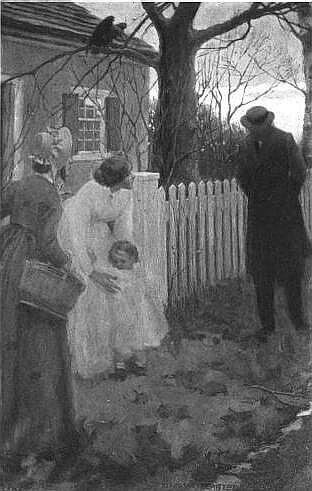
THE SEXTON stood in the porch of Milford meetinghouse, pulling busily at the bell rope. The old people of the village came stooping along the street. Children, with bright faces, tripped merrily beside their parents, or mimicked a graver gait, in the conscious dignity of their Sunday clothes. Spruce bachelors looked sidelong at the pretty maidens, and fancied that the Sabbath sunshine made them prettier than on weekdays. When the throng had mostly streamed into the porch, the sexton began to toll the bell, keeping his eye on the Reverend Mr. Hooper's door. The first glimpse of the clergyman's figure was the signal for the bell to cease its summons.
"But what has good Parson Hooper got upon his face?" cried the sexton in astonishment.
All within hearing immediately turned about, and beheld the semblance of Mr. Hooper, pacing slowly his meditative way toward the meetinghouse. With one accord they started, expressing more wonder than if some strange minister were coming to dust the cushions of Mr. Hooper's pulpit.
"Are you sure it is our parson?" inquired Goodman Gray of the sexton.
"Of a certainty it is good Mr. Hooper," replied the sexton. "He was to have exchanged pulpits with Parson Shute, of Westbury; but Parson Shute sent to excuse himself yesterday, being to preach a funeral sermon."
The cause of so much amazement may appear sufficiently slight. Mr. Hooper gentlemanly person, of about thirty, though still a bachelor, was dressed with due clerical neatness, as if a careful wife had starched his band, and brushed the weekly dust from his Sunday's garb. There was but one thing remarkable in his appearance. Swathed about his forehead, and hanging down over his face, so low as to be shaken by his breath Mr. Hooper had on a black veil. On a nearer view it seemed to consist of two folds of crepe, which entirely concealed his features, except the mouth and chin, but probably did not intercept his sight, further than to give a darkened aspect to all living and inanimate things. With this gloomy shade before him, good Mr. Hooper walked onward, at a slow and quiet pace, stooping somewhat, and looking on the ground, as is customary with abstracted men, yet nodding kindly to those of his parishioners who still waited on the meetinghouse steps. But so wonderstruck were they that his greeting hardly met with a return.
"I can't really feel as if good Mr. Hooper's face was behind that piece of crape," said the sexton.
"I don't like it," muttered an old woman, as she hobbled into the meetinghouse. "He has changed himself into something awful, only by hiding his face."
"Our parson has gone mad!" cried Goodman Gray, following him across the threshold.
A rumor of some unaccountable phenomenon had preceded Mr. Hooper into the meetinghouse, and set all the congregation astir. Few could refrain from twisting their heads toward the door; many stood upright, and turned directly about while several little boys clambered upon the seats, and came down again with a terrible racket. There was a general bustle, a rustling of the women's gowns and shuffling of the men's feet, greatly at variance with that hushed repose which should attend the entrance of the minister. But Mr. Hooper appeared not to notice the perturbation of his people. He entered with an almost noiseless step, bent his head mildly to the pews on each side, and bowed as he passed his oldest parishioner, a whitehaired great-grandsire, who occupied an armchair in the center of the aisle. It was strange to observe how slowly this venerable man became conscious of something singular in the appearance of his pastor. He seemed not fully to partake of the prevailing wonder, till Mr. Hooper had ascended the stairs, and showed himself in the pulpit, face to face with his congregation, except for the black veil. That mysterious emblem was never once withdrawn. It shook with his measured breath, as he gave out the psalm; it threw its obscurity between him and the holy page, as he read the Scriptures; and while he prayed, the veil lay heavily on his uplifted countenance. Did he seek to hide it from the dread Being whom he was addressing?
Such was the effect of this simple piece of crepe, that more than one woman of delicate nerves was forced to leave the meetinghouse. Yet perhaps the pale-faced congregation was almost as fearful a sight to the minister, as his black veil to them.
Mr. Hooper had the reputation of a good preacher, but not an energetic one; he strove to win his people heavenward by mild, persuasive influences, rather than to drive them thither by the thunders of the Word. The sermon which he now delivered was marked by the same characteristics of style and manner as the general series of his pulpit oratory. But there was something, either in the sentiment of the discourse itself, or in the imagination of the auditors, which made it greatly the most powerful effort that they had ever heard from their pastor's lips. It was tinged, rather more darkly than usual, with the gentle gloom of Mr. Hooper's temperament. The subject had reference to secret sit, and those sad mysteries which we hide from our nearest and dearest and would fain conceal from our own consciousness, even forgetting that the Omniscient can de tect them. A subtle power was breathed into his words. Each member of the congregation, the most innocent girl, and the man of hardened breast, felt as if the preacher had crept upon them, behind his awful veil, and discovered their hoarded iniquity of deed or thought. Many spread their clasped hands on their bosoms. There was nothing terrible in what Mr. Hooper said, at least no violence; and yet, with every tremor of his melancholy voice, the hearers quaked. An unsought pathos came hand in hand with awe. So sensible were the audience of some unwonted attribute in their minister, that they longed for a breath of wind to blow aside the veil, almost believing that a stranger's visage would be discovered, though the form, gesture, and voice were those of Mr. Hooper.
At the close of the services, the people hurried out with indecorous confusion, eager to communicate their pent-up amazement, and conscious of lighter spirits the moment they lost sight of the black veil. Some gathered in little circles, huddled closely together, with their mouths all whispering in the center; some went homeward alone, wrapt in silent meditation; some talked loudly, and profaned the Sabbath day with ostentatious laughter. A few shook, their sagacious heads, intimating that they could penetrate the mystery; while one or two affirmed that there was no mystery at all, but only that Mr. Hooper's eyes were so weakened by the midnight lamp as to require a shade. After a brief interval, forth came good Mr. Hooper also, in the rear of his flock. Turning his veiled face from one group to another, he paid due reverence to the hoary heads, saluted the middle-aged with kind dignity as their friend and spiritual guide, greeted the young with mingled authority and love, and laid his hands on the little children's heads to bless them. Such was always his custom on the Sabbath day. Strange and bewildered looks repaid him for his courtesy. None, as on former occasions, aspired to the honor of walking by their pastor's side. Old Squire Saunders, doubtless by an accidental lapse of memory, neglected to invite Mr. Hooper to his table, where the good clergyman had been wont to bless the food, almost every Sunday since his settlement. He returned, therefore, to the parsonage, and, at the moment of closing the door, was observed to look back upon the people, all of whom had their eyes fixed upon the minister. A sad smile gleamed faintly from beneath the black veil, and flickered about his mouth, glimmering as he disappeared. "How strange," said a lady, "that a simple black veil, such as any woman might wear on her bonnet, should become such a terrible thing on Mr. Hooper's face."
"Something must surely be amiss with Hooper's intellects," observed her husband, the physician of the village. "But the strangest part of the affair is the effect of this vagary, even on a sober-minded man like myself. The black veil, though it covers only our pastor's face, throws its influence over his whole person, and makes him ghostlike from head to foot. Do you not feel it so?"
"Truly do I," replied the lady; "and I would not be alone with him for the world. I wonder he is not afraid to be alone with himself!"
"Men sometimes are so," said her husband.
The afternoon service was attended with similar circumstances. At its conclusion, the bell tolled for the funeral of a young lady. The relatives and friends were assembled in the house, and the more distant acquaintances stood about the door, speaking of the good qualities of the deceased, when their talk was interrupted by the appearance of Mr. Hooper, still covered with his black veil. It was now an appropriate emblem. The clergyman stepped into the room where the corpse was laid, and bent over the coffin, to take a last farewell of his deceased parishioner. As he stooped, the veil hung straight down from his forehead, so that, if her eyelids had not been dosed forever, the dead maiden might have seen his face. Could Mr. Hooper be fearful of her glance, that he so hastily caught back the black veil? A person who watched the interview between the dead and the living scrupled not to affirm, that, at the instant when the clergyman's features were disclosed, the corpse had slightly shuddered, rustling the shroud and muslin cap, though the countenance retained the composure of death. A superstitious old woman was the only witness of this prodigy. From the coffin Mr. Hooper passed into the chamber of the mourners, and thence to the head of the staircase, to make the funeral prayer. It was a tender and heart-dissolving prayer, full of sorrow, yet so imbued with celestial hopes, that the music of a heavenly harp, swept by the fingers of the dead, seemed faintly to be heard among the saddest accents of the minister. The people trembled, though they but darkly understood him when he prayed that they, and himself, and all of mortal race, might be ready, as he trusted this young maiden had been, for the dreadful hour that should snatch the veil from their faces. The bearers went heavily forth, and the mourners followed, saddening all the street, with the dead before them, and Mr. Hooper in his black veil behind.
"Why do- you look back?" said one in the procession to his partner. "I had a fancy," replied she, "that the minister and the maiden's spirit were walking hand in hand."
"And so had I, at the same moment," said the other.
That night, the handsomest couple in Milford village were to be joined in wedlock. Though reckoned a melancholy man, Mr. Hooper had a placid cheerfulness for such occasions, which often excited a sympathetic smile where livelier merriment would have been thrown away. There was no quality of his disposition which made him more beloved than this. The company at the wedding awaited his arrival with impatience, trusting that the strange awe, which had gathered over him throughout the day, would now be dispelled. But such was not the result. When Mr. Hooper came, the first thing that their eyes rested on was the same horrible black veil, which had added deeper gloom to the funeral, and could portend nothing but evil to the wedding. Such was its immediate effect on the guests that a cloud seemed to have rolled duskily from beneath the black crepe, and dimmed the light of the candles. The bridal pair stood up before the minister. But the bride's cold fingers quivered in the tremulous hand of the bridegroom, and her deathlike paleness caused a whisper that the maiden who had been buried a few hours before was come from her grave to be married. If ever another wedding were so dismal, it was that famous one where they tolled the wedding knell. After performing the ceremony, Mr. Hooper raised a glass of wine to his lips, wishing happiness to the new-married couple in a strain of mild pleasantry that ought to have brightened the features of the guests, like a cheerful gleam from the hearth. At that instant, catching a glimpse of his figure in the looking glass, the black veil involved his own spirit in the horror with which it overwhelmed all others. His frame shuddered his lips grew white, he spilt the untasted wine upon the carpet, and rushed forth into the darkness. For the Earth, too, had on her Black Veil.
The next day, the whole village of Milford talked of little else than Parson Hooper's black veil. That, and the mystery concealed behind it, supplied a topic for discussion between acquaintances meeting in the street, and good women gossiping at their open windows. It was the first item of news that the tavernkeeper told to his guests. The children babbled of it on their way to school. One imitative little imp covered his face with an old black handkerchief, thereby so affrighting his playmates that the panic seized himself, and he well-nigh lost his wits by his own waggery.
It was remarkable that of all the busybodies and impertinent people in the parish, not one ventured to put the plain question to Mr. Hooper, wherefore he did this thing. Hitherto, whenever there appeared the slightest call for such interference, he had never lacked advisers, nor shown himself averse to be guided by their judgment. If he erred at all, it was by so painful a degree of self-distrust, that even the mildest censure would lead him to consider an indifferent action as a crime. Yet, though so well acquainted with this amiable weakness, no individual among his parishioners chose to make the black veil a subject of friendly remonstrance. There was a feeling of dread, neither plainly confessed nor carefully concealed, which caused each to shift the responsibility upon another, till at length it was found expedient to send a deputation of the church, in order to deal with Mr. Hooper about the mystery, before it should grow into a scandal. Never did an embassy so ill discharge its duties. The minister received them with friendly courtesy, but remained silent, after they were seated, leaving to his visitors the whole burden of introducing their important business. The topic, it might be supposed, was obvious enough. There was the black veil swathed round Mr. Hooper's forehead, and concealing every feature above his placid mouth, on which, at times, they could perceive the glimmering of a melancholy smile. But that piece of crepe, to their imagination, seemed to hang down before his heart, the symbol of a fearful secret between him and them. Were the veil but cast aside, they might speak freely of it, but not till then. Thus they sat a considerable time, speechless, confused, and shrinking uneasily from Mr. Hooper's eye, which they felt to be fixed upon them with an invisible glance. Finally, the deputies returned abashed to their constituents, pronouncing the matter too weighty to be handled, except by a council of the churches, if, indeed, it might not require a general synod.
But there was one person in the village unappalled by the awe with which the black veil had impressed all besides herself. When the deputies returned without an explanation, or even venturing to demand one, she, with the calm energy of her character, determined to chase away the strange cloud that appeared to be settling round Mr. Hooper, every moment more darkly than before. As his plighted wife, it should be her privilege to know what the black veil concealed. At the minister's first visit, therefore, she entered upon the subject with a direct simplicity, which made the task easier both for him and her, After he had seated himself, she fixed her eyes steadfastly upon the veil, but could discern nothing of the dreadful gloom that had so overawed the multitude; it was but a double fold of crepe, hanging down from his forehead to his mouth, and slightly stirring with his breath.
"No," said she aloud, and smiling, "there is nothing terrible in this piece of crepe, except that it hides a face which I am always glad to look upon. Come, good sir, let the sun shine from behind the cloud. First lay aside your black veil; then tell me why you put it on."
Mr. Hooper's smile glimmered faintly.
"There is an hour to come," said he, "when all of us shall cast aside our veils. Take it not amiss, beloved friend, if I wear this piece of crepe till then."
"Your words are a mystery, too," returned the young lady. "Take away the veil from them, at least."
"Elizabeth, I will," said he, "so far as my vow may suffer me. Know, then, this veil is a type and a symbol, and I am bound to wear it ever, both in light and darkness, in solitude and before the gaze of multitudes, and as with strangers, so with my familiar friends. No mortal eye will see it withdrawn. This dismal shade must separate me from the world; even you, Elizabeth, can never come behind it!"
"What grievous affliction hath befallen you," she earnestly inquired, "that you should thus darken your eyes forever?"
"If it be a sign of mourning," replied Mr. Hooper, "I, perhaps, like most other mortals, have sorrows dark enough to be typified by a black veil."
"But what if the world will not believe that it is the type of an innocent sorrow?" urged Elizabeth. "Beloved and respected: as you are, there may be whispers that you hide your face under the consciousness of secret sin. For the sake of your holy office, do away this scandal!"
The color rose into her cheeks as she intimated the nature of the rumors that were already abroad in the village. But Mr. Hooper's mildness did not forsake him. He even smiled again--that same sad smile, which always appeared like a faint glimmering of light, proceeding from the obscurity beneath the veil.
"If I hide my face for sorrow, there is cause enough;" he merely replied; "and if I cover it for secret sin, what mortal might not do the same?"
And with this gentle, but unconquerable obstinacy did he resist her entreaties. At length Elizabeth sat silent. For a few momeets she appeared lost in thought, considering, probably, what new methods might be tried to withdraw her foyer from so dark a fantasy, which, if it had no other meaning, was perhaps a symptom of mental disease. Though of a firmer character than his own, the tears rolled down her cheeks. But, in an instant, as it were, a new feeling took the place of sorrow; her eyes were fixed insensibly on the black veil, when, like a sudden twilight in the air, its terrors: fell around her. She arose, and stood trembling before him.
"And do you feel it then, at last?" said he, mournfully.
She made no reply, but covered her eyes with her hand, and turned to leave the room. He rushed forward and caught her arm.
"Have patience with me, Elizabeth!" cried he, passionately. "Do not desert me, though this veil must be between us here on earth. Be mine, and hereafter there shall be no veil over my face, no darkness between our souls! It is but a mortal veil--it is not for eternity! O! you know not how lonely I am, and how frightened, to be alone behind my black veil. Do not leave me in this miserable obscurity forever!"
"Lift the veil but once, and look me in the face," said she.
"Never! It cannot be!" replied Mr. Hooper.
"Then farewell!" said Elizabeth.
She withdrew her arm from his grasp, and slowly departed, pausing at the door, to give one long shuddering gaze, that seemed almost to penetrate the mystery of the black veil. But, even amid his grief, Mr. Hooper smiled to think that only a material emblem had separated him from happiness, though the horrors which it shadowed forth must be drawn darkly between the fondest of lovers.
From that time no attempts were made to remove Mr. Hooper's black veil, or, by a direct appeal, to discover the secret which it was supposed to hide. By persons who claimed a superiority to popular prejudice, it was reckoned more an eccentric whim, such as often mingles with the sober actions of men otherwise rational, and tinges them all with its own semblance of insanity. But with the multitude, good Mr. Hooper was irreparably a bugbear. He could not walk the street with any peace of mind, so conscious was he that the gentle and timid would turn aside to avoid him, and that others would make it a point of hardihood to throw themselves in his way. The impertinence of the latter class compelled him to give up his customary walk at sunset to the burial ground; for when he leaned pensively over the gate, there would always be faces behind the gravestones, peeping at his black veil. A fable went the rounds that the stare of the dead people drove him thence. It grieved him, to the very depth of his kind heart, to observe how the children fled from his approach, breaking up their merriest sports, while his melancholy figure was yet afar off. Their instinctive dread caused him to feel more strongly than aught else that a preternatural horror was interwoven with the threads of the black crape. In truth, his own antipathy to the veil was known to be l so great, that he never willingly passed before a mirror, nor stooped to drink at a still fountain, lest, in its peaceful bosom, he should be affrighted by himself. This was what gave plausibility to the whispers, that Mr. Hooper's conscience tortured him for some great crime too horrible to be entirely concealed, or. otherwise than so obscurely intimated. Thus, from beneath the black veil, there rolled a cloud into the sunshine, an ambiguity of sin or sorrow, which enveloped the poor minister, so that love or sympathy could never reach him. It was said that ghost and fiend consorted with him there. With self-shudderings and outward terrors, he walked continually in its shadow, groping darkly within his own soul, or gazing through a medium that saddened the whole world. Even the lawless wind, it was believed, respected his dreadful secret, and never blew aside the veil. But still good Mr. Hooper sadly smiled at the pale visages of the worldly throng as he passed by.
Among all its bad influences, the black veil had the one desirable effect, of making its wearer a very efficient clergyman. By the aid of his mysterious emblem--for there was no other apparent cause--he became a man of awful power over souls that were in agony of sin. His converts always regarded him with a dread peculiar to themselves, affirming, though but figuratively, that, before he brought them to celestial light, they had been with him behind the black veil. Its gloom, indeed, enabled him to sympathize with all dark affections. Dying sinners cried aloud for Mr. Hooper, and would not yield their breath till he appeared; though ever, as he stooped to whisper consolation, they shuddered at the veiled face so near their own. Such were the terrors of the black veil, even when Death had bared his visage! Strangers came long distances to attend service at his church, with the mere idle purpose of gazing at his figure, because it was forbidden them to behold his face. But many were made to quake ere they departed! Once, during Governor Belcher's administration, Mr. Hooper was appointed to preach the election sermon. Covered with his black veil, he stood before the chief magistrate, the council, and the representatives, and wrought so deep an impression, that the legislative measures of that year were characterized by all the gloom and piety of our earliest ancestral sway.
In this manner Mr. Hooper spent a long life, irreproachable in outward act, yet shrouded in dismal suspicions; kind and loving, though unloved, and dimly feared; a man apart from men, shunned in their health and joy, but ever summoned to their aid in mortal anguish. As years wore on, shedding their snows above his sable veil, he acquired a name throughout the New England churches, and they called him Father Hooper. Nearly all his parishioners, who were of mature age when he was settled, had been borne away by many a funeral; he had one congregation in the church, and a more crowded one in the churchyard; and having wrought so late into the evening, and done his work so well, it was now good Father Hooper's turn to rest.
Several persons were visible by the shaded candlelight, in the death chamber of the old clergyman. Natural connections he had none. But there was the decorously grave, though unmoved physician, seeking only to mitigate the last pangs of the patient whom he could not save. There were the deacons, and other eminently pious members of his church. There, also, was the Reverend Mr. Clark, of Westbury, a young and zealous divine, who had ridden in haste to pray by the bedside of the expiring minister. There was the nurse, no hired handmaiden of death, but one whose calm affection had endured thus long in secrecy, in solitude, amid the chill of age, and would not perish, even at the dying hour. Who, but Elizabeth! And there lay the hoary head of good Father Hooper upon the death pillow, with the black veil still swathed about his brow, and reaching down over his face, so that each more difficult gasp of his faint breath caused it to stir. All through life that piece of crepe had hung between him and the world; it had separated him from cheerful brotherhood and woman's love, arid kept him in that saddest of all prisons, his own heart; and still it lay upon his face, as if to deepen the gloom of his darksome chamber, and shade him from the sunshine of eternity.
For some time previous, his mind had been confused, wavering doubtfully between the past and the present, and hovering forward, as it were, at intervals, into the indistinctness of the world to come. There had been feverish turns, which tossed him from side to side, and wore away what little strength he had. But in his most convulsive struggles, and in the wildest vagaries of his intellect, when no other thought retained its sober influence, he still showed an awful solicitude lest the black veil should slip aside. Even if his bewildered soul could have forgotten, there was a faithful woman at his pillow, who, with averted eyes, would have covered that aged face, which she had last beheld in the comeliness of manhood. At length the deathstricken old man lay quietly in the torpor of mental and bodily exhaustion, with an imperceptible pulse, and breath that grew fainter and fainter, except when a long, deep, and irregular inspiration seemed to prelude the flight of his spirit.
The minister of Westbury approached the bedside.
"Venerable Father Hooper," said he, "the moment of your release is at hand. Are you ready for the lifting of the veil that shuts in time from eternity?" Father Hooper at first replied merely by a feeble motion of his head; then, apprehensive, perhaps, that his meaning might be doubtful, he exerted himself to speak.
"Yea," said he, in faint accents, "my soul hath a patient weariness until that veil be lifted."
"And is it fitting," resumed the Reverend Mr. Clark, "that a man so given to prayer, of such a blameless example, holy in deed and thought, so far as mortal judgment may pronounce; is it fitting that a father in the church should leave a shadow on his memory, that may seem to blacken a life so pure? I pray you, my venerable brother, let not this thing be! Suffer us to be gladdened by your triumphant aspect as you go to your reward. Before the veil of eternity be lifted, let me cast aside this black veil from your face!"
And thus speaking the Reverend Mr. Clark bent forward to reveal the mystery of so many years. But, exerting a sudden energy, that made all the beholders stand aghast, Father Hooper snatched both his hands from beneath the bedclothes, and pressed them strongly on the black veil, resolute to struggle, if the minister of Westbury would contend with a dying man.
"Never!" cried the veiled clergyman. "On earth, never!"
"Dark old men!" exclaimed the affrighted minister, "with what horrible crime upon your soul are you now passing to the judgment?"
Father Hooper's breath heaved; it rattled in his throat; but, with a mighty effort, grasping forward with his hands, he caught hold of life, and held it back till he should speak, He even raised himself in bed; and there he sat, shivering with the arms of death around him, while the black veil hung down, awful, at that last moment, in the gathered terrors of a lifetime. And yet the faint, sad smile, so often there, now seemed to glimmer from its obscurity, and linger on Father Hooper's lips.
"Why do you tremble at me alone?" cried he, turning his veiled face round the circle of pale spectators. "Tremble also at each others Have men avoided me, and women shown no pity, and children screamed and fled, only for my black veil? What, but the mystery which it obscurely typifies, has made this piece of crepe so awful? When the friend shows his inmost heart to his friend; the lover to his best beloved; when man does not vainly shrink from the eye of his Creator, loathsomely treasuring up the secret of his sin; then deem me a monster, for the symbol beneath which I have lived, and die! I look around me, and, lo! on every visage a Black Veil."
While his auditors shrank from one another, in mutual affright, Father Hooper fell back upon his pillow, a veiled corpse, with a faint smile lingering on the lips. Still veiled, they laid him in his coffin, and a veiled corpse they bore. him to the grave. The grass of many years has sprung up and withered on that grave, the burial stone is moss-grown, and good Mr. Hooper's face is dust; but awful is still the thought that it moldered beneath the Black Veil!
Visit our study guides created to benefit teachers and students: The Minister's Black Veil Study Guide and Dark Romanticism Study Guide
Frequently Asked Questions
What is "The Minister's Black Veil" about?
"The Minister's Black Veil" is a short story by Nathaniel Hawthorne, first published in 1836 as part of his collection Twice-Told Tales. The story follows Reverend Mr. Hooper, a well-liked Puritan minister in the village of Milford, who one Sunday appears before his congregation wearing a black veil over his face. The veil conceals all of his features except his mouth and chin, and he refuses to remove it for the rest of his life. The congregation is disturbed and frightened by the veil, and even his fiancée, Elizabeth, breaks off their engagement when he will not take it off. Despite his increasing isolation, Hooper becomes a more powerful and effective clergyman, especially among dying sinners. On his deathbed, he delivers a final speech declaring that every person wears a metaphorical black veil, hiding their sins from one another and from God.
What does the black veil symbolize in Hawthorne's story?
The black veil is a multilayered symbol that operates on several levels. Most directly, it represents secret sin — the hidden guilt and moral failings that every person conceals from others and sometimes even from themselves. Hawthorne subtitles the work "A Parable," signaling that the veil carries a moral lesson beyond its literal meaning. The veil also symbolizes the barriers people erect between themselves and others: just as the physical crepe separates Hooper from his congregation, the secrets we keep create emotional and spiritual isolation. On a broader level, the veil represents the impossibility of true human connection so long as people refuse to be honest about their own nature. Hooper's final words make this explicit: he sees "a Black Veil" on every face around him, suggesting that his piece of crepe merely makes visible what everyone else hides.
What is the theme of "The Minister's Black Veil"?
The central theme of "The Minister's Black Veil" is the universality of secret sin and the hypocrisy of those who refuse to acknowledge it. Hawthorne explores how every person harbors hidden guilt, yet the community reacts with horror when one man chooses to outwardly acknowledge this truth. A closely related theme is isolation and alienation: Hooper's veil separates him from society, love, and human warmth, illustrating how secrecy and guilt inevitably create distance between people. The story also examines the gap between appearance and reality in Puritan society — the congregation prides itself on moral uprightness while being deeply uncomfortable with any reminder of their own sinfulness. Finally, Hawthorne explores the nature of empathy and judgment: rather than recognizing Hooper's veil as a mirror of their own condition, the townspeople project their fears onto him, treating him as a pariah.
Why does Mr. Hooper wear the black veil?
Hawthorne deliberately leaves Mr. Hooper's exact motivation ambiguous, which is central to the story's power. Hooper himself offers only oblique explanations, telling Elizabeth that the veil is "a type and a symbol" that he is bound to wear forever. He implies that it represents the universal human condition of concealed sinfulness, saying, "If I hide my face for sorrow, there is cause enough; and if I cover it for secret sin, what mortal might not do the same?" Some readers and scholars interpret the veil as Hooper's response to a specific personal sin — possibly connected to the young woman whose funeral he attends on the same day he first dons the veil. Others read it as a purely symbolic act: a minister choosing to physically embody the doctrine of universal sinfulness he preaches from the pulpit. The ambiguity is intentional — Hawthorne forces readers to confront the same uncertainty that torments Hooper's congregation.
Who is Elizabeth in "The Minister's Black Veil"?
Elizabeth is Mr. Hooper's fiancée and the only person in Milford who is not initially afraid of the black veil. She approaches Hooper with "the calm energy of her character" and directly asks him to remove the veil and explain his reasons for wearing it. When Hooper refuses, Elizabeth pleads with him, warning that the veil will cause scandal and whispers of secret sin. She gives him an ultimatum — "Lift the veil but once, and look me in the face" — and when he refuses, she breaks off their engagement. Despite this, Elizabeth never marries anyone else, and she reappears at Hooper's deathbed decades later as his faithful nurse. Her character represents the possibility of genuine love and human connection, making her departure all the more tragic: Hooper's commitment to his symbolic veil costs him the one person willing to see past it.
What is the moral of "The Minister's Black Veil"?
Hawthorne subtitles the story "A Parable," and its moral is delivered most powerfully in Mr. Hooper's dying words: "Why do you tremble at me alone? Tremble also at each other!" The moral is that every person conceals sins and shameful truths behind a figurative veil, yet society hypocritically condemns the one man honest enough to acknowledge this openly. Rather than examining their own consciences, the townspeople project all their discomfort onto Hooper, treating him as a monster while ignoring the "Black Veil" on their own faces. The story also warns that secrecy and self-deception destroy human relationships: Hooper's isolation is tragic, but it mirrors the quieter isolation that afflicts everyone who hides their true self from those they love. Hawthorne suggests that genuine connection requires vulnerability and honesty about our shared imperfections.
What genre is "The Minister's Black Veil"?
"The Minister's Black Veil" belongs to several overlapping literary genres. It is primarily a work of Dark Romanticism, the American literary movement that explored the darker aspects of human nature, sin, guilt, and the psychological depths that Transcendentalists tended to overlook. Hawthorne, along with Edgar Allan Poe and Herman Melville, is considered a central figure in this tradition. The story is also an allegory and a parable — Hawthorne himself subtitles it "A Parable," indicating that the narrative is meant to convey a moral or spiritual truth beyond its literal plot. Additionally, the story contains elements of Gothic fiction, including its atmosphere of dread, the mysterious and unexplained nature of the veil, and the psychological terror it produces in the community.
What happens at the end of "The Minister's Black Veil"?
At the end of the story, the aged Father Hooper (as the townspeople now call him) lies on his deathbed, attended by a physician, deacons, the young Reverend Mr. Clark, and Elizabeth, who has served as his nurse despite their broken engagement. When Reverend Clark asks Hooper to remove the veil as a final act before meeting his Creator, Hooper summons a burst of energy and presses his hands over the veil, refusing with the cry "Never! On earth, never!" He then delivers his final speech, asking why people have trembled at him alone when every person wears their own black veil, hiding their sins from friends, lovers, and God. He declares, "I look around me, and, lo! on every visage a Black Veil!" Hooper dies with a faint smile on his lips, and he is buried with the veil still covering his face — a veiled corpse carried to a veiled grave.
What literary devices does Hawthorne use in "The Minister's Black Veil"?
Hawthorne employs a rich array of literary devices throughout the story. The most prominent is symbolism: the black veil itself is the central symbol, representing secret sin, hidden guilt, and the barriers between people. Irony pervades the narrative — the congregation, who all harbor their own secret sins, are horrified by a man who merely acknowledges this truth with a piece of crepe. Hawthorne uses light and dark imagery extensively, contrasting the Sabbath sunshine with the gloom of the veil, and describing how the veil's darkness overcomes the light of candles at the wedding. The story also makes powerful use of ambiguity as a deliberate narrative strategy: Hawthorne never confirms whether Hooper has committed a specific sin or wears the veil purely as a symbol. Hooper's recurring "sad smile" functions as a motif, appearing throughout the story to suggest his awareness of a truth others refuse to see.
How does "The Minister's Black Veil" compare to Hawthorne's other works?
"The Minister's Black Veil" shares thematic concerns with many of Hawthorne's other works, particularly his exploration of hidden sin, guilt, and Puritan hypocrisy. The story is often read alongside "Young Goodman Brown", another tale set in Puritan New England that examines how awareness of universal sinfulness can destroy a person's ability to connect with others. Where Goodman Brown's discovery of evil leads to bitterness and misanthropy, Hooper's veil makes him a more compassionate minister, though equally isolated. The theme of concealed guilt also connects to The Scarlet Letter, in which Reverend Dimmesdale hides his sin while Hester Prynne is forced to display hers publicly. Stories like "The Birthmark" and "Rappaccini's Daughter" similarly explore how obsession with a single idea or symbol can lead to tragic isolation from the people one loves.
Save stories, build your reading list, and access all study tools — completely free.
Save The Minister's Black Veil to your library — it's free!Need help with The Minister's Black Veil?
Study tools to help with homework, prepare for quizzes, and deepen your understanding.
Flashcards → | Study Guide →