The Gift of the Magi
by O. Henry
A young married couple-- rich in love, poor in money-- buy each other gifts and teach all of us about sacrifice and giving. Published in O'Henry's story collection, The Four Million in 1906.
One dollar and eighty-seven cents. That was all. And sixty cents of it was in pennies. Pennies saved one and two at a time by bulldozing the grocer and the vegetable man and the butcher until one's cheeks burned with the silent imputation of parsimony that such close dealing implied. Three times Della counted it. One dollar and eighty-seven cents. And the next day would be Christmas.
There was clearly nothing left to do but flop down on the shabby little couch and howl. So Della did it. Which instigates the moral reflection that life is made up of sobs, sniffles, and smiles, with sniffles predominating.
While the mistress of the home is gradually subsiding from the first stage to the second, take a look at the home. A furnished flat at $8 per week. It did not exactly beggar description, but it certainly had that word on the look-out for the mendicancy squad.
In the vestibule below was a letter-box into which no letter would go, and an electric button from which no mortal finger could coax a ring. Also appertaining thereunto was a card bearing the name "Mr. James Dillingham Young."
The "Dillingham" had been flung to the breeze during a former period of prosperity when its possessor was being paid $30 per week. Now, when the income was shrunk to $20, the letters of "Dillingham" looked blurred, as though they were thinking seriously of contracting to a modest and unassuming D. But whenever Mr. James Dillingham Young came home and reached his flat above he was called "Jim" and greatly hugged by Mrs. James Dillingham Young, already introduced to you as Della. Which is all very good.
Della finished her cry and attended to her cheeks with the powder rag. She stood by the window and looked out dully at a grey cat walking a grey fence in a grey backyard. To-morrow would be Christmas Day, and she had only $1.87 with which to buy Jim a present. She had been saving every penny she could for months, with this result. Twenty dollars a week doesn't go far. Expenses had been greater than she had calculated. They always are. Only $1.87 to buy a present for Jim. Her Jim. Many a happy hour she had spent planning for something nice for him. Something fine and rare and sterling--something just a little bit near to being worthy of the honour of being owned by Jim.
There was a pier-glass between the windows of the room. Perhaps you have seen a pier-glass in an $8 Bat. A very thin and very agile person may, by observing his reflection in a rapid sequence of longitudinal strips, obtain a fairly accurate conception of his looks. Della, being slender, had mastered the art.
Suddenly she whirled from the window and stood before the glass. Her eyes were shining brilliantly, but her face had lost its colour within twenty seconds. Rapidly she pulled down her hair and let it fall to its full length.
Now, there were two possessions of the James Dillingham Youngs in which they both took a mighty pride. One was Jim's gold watch that had been his father's and his grandfather's. The other was Della's hair. Had the Queen of Sheba lived in the flat across the airshaft, Della would have let her hair hang out of the window some day to dry just to depreciate Her Majesty's jewels and gifts. Had King Solomon been the janitor, with all his treasures piled up in the basement, Jim would have pulled out his watch every time he passed, just to see him pluck at his beard from envy.
So now Della's beautiful hair fell about her, rippling and shining like a cascade of brown waters. It reached below her knee and made itself almost a garment for her. And then she did it up again nervously and quickly. Once she faltered for a minute and stood still while a tear or two splashed on the worn red carpet.
On went her old brown jacket; on went her old brown hat. With a whirl of skirts and with the brilliant sparkle still in her eyes, she cluttered out of the door and down the stairs to the street.
Where she stopped the sign read: "Mme Sofronie. Hair Goods of All Kinds." One Eight up Della ran, and collected herself, panting. Madame, large, too white, chilly, hardly looked the "Sofronie."
"Will you buy my hair?" asked Della.
"I buy hair," said Madame. "Take yer hat off and let's have a sight at the looks of it."
Down rippled the brown cascade.
"Twenty dollars," said Madame, lifting the mass with a practised hand.
"Give it to me quick" said Della.
Oh, and the next two hours tripped by on rosy wings. Forget the hashed metaphor. She was ransacking the stores for Jim's present.
She found it at last. It surely had been made for Jim and no one else. There was no other like it in any of the stores, and she had turned all of them inside out. It was a platinum fob chain simple and chaste in design, properly proclaiming its value by substance alone and not by meretricious ornamentation--as all good things should do. It was even worthy of The Watch. As soon as she saw it she knew that it must be Jim's. It was like him. Quietness and value--the description applied to both. Twenty-one dollars they took from her for it, and she hurried home with the 78 cents. With that chain on his watch Jim might be properly anxious about the time in any company. Grand as the watch was, he sometimes looked at it on the sly on account of the old leather strap that he used in place of a chain.
When Della reached home her intoxication gave way a little to prudence and reason. She got out her curling irons and lighted the gas and went to work repairing the ravages made by generosity added to love. Which is always a tremendous task dear friends--a mammoth task.
Within forty minutes her head was covered with tiny, close-lying curls that made her look wonderfully like a truant schoolboy. She looked at her reflection in the mirror long, carefully, and critically.
"If Jim doesn't kill me," she said to herself, "before he takes a second look at me, he'll say I look like a Coney Island chorus girl. But what could I do--oh! what could I do with a dollar and eighty-seven cents?"
At 7 o'clock the coffee was made and the frying-pan was on the back of the stove hot and ready to cook the chops.
Jim was never late. Della doubled the fob chain in her hand and sat on the corner of the table near the door that he always entered. Then she heard his step on the stair away down on the first flight, and she turned white for just a moment. She had a habit of saying little silent prayers about the simplest everyday things, and now she whispered: "Please, God, make him think I am still pretty."
The door opened and Jim stepped in and closed it. He looked thin and very serious. Poor fellow, he was only twenty-two--and to be burdened with a family! He needed a new overcoat and he was with out gloves.
Jim stepped inside the door, as immovable as a setter at the scent of quail. His eyes were fixed upon Della, and there was an expression in them that she could not read, and it terrified her. It was not anger, nor surprise, nor disapproval, nor horror, nor any of the sentiments that she had been prepared for. He simply stared at her fixedly with that peculiar expression on his face.
Della wriggled off the table and went for him.
"Jim, darling," she cried, "don't look at me that way. I had my hair cut off and sold it because I couldn't have lived through Christmas without giving you a present. It'll grow out again--you won't mind, will you? I just had to do it. My hair grows awfully fast. Say 'Merry Christmas!' Jim, and let's be happy. You don't know what a nice-what a beautiful, nice gift I've got for you."
"You've cut off your hair?" asked Jim, laboriously, as if he had not arrived at that patent fact yet, even after the hardest mental labour.
"Cut it off and sold it," said Della. "Don't you like me just as well, anyhow? I'm me without my hair, ain't I?"
Jim looked about the room curiously.
"You say your hair is gone?" he said, with an air almost of idiocy.
"You needn't look for it," said Della. "It's sold, I tell you--sold and gone, too. It's Christmas Eve, boy. Be good to me, for it went for you. Maybe the hairs of my head were numbered," she went on with a sudden serious sweetness, "but nobody could ever count my love for you. Shall I put the chops on, Jim?"
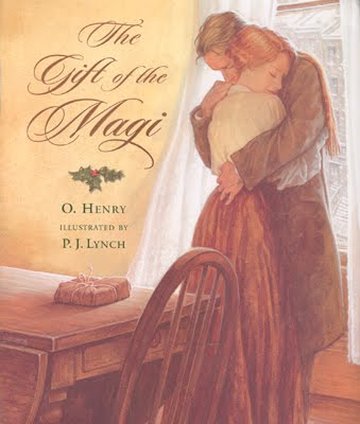
Out of his trance Jim seemed quickly to wake. He enfolded his Della. For ten seconds let us regard with discreet scrutiny some inconsequential object in the other direction. Eight dollars a week or a million a year--what is the difference? A mathematician or a wit would give you the wrong answer. The magi brought valuable gifts, but that was not among them. This dark assertion will be illuminated later on.
Jim drew a package from his overcoat pocket and threw it upon the table.
"Don't make any mistake, Dell," he said, "about me. I don't think there's anything in the way of a haircut or a shave or a shampoo that could make me like my girl any less. But if you'll unwrap that package you may see why you had me going a while at first."
White fingers and nimble tore at the string and paper. And then an ecstatic scream of joy; and then, alas! a quick feminine change to hysterical tears and wails, necessitating the immediate employment of all the comforting powers of the lord of the flat.
For there lay The Combs--the set of combs, side and back, that Della had worshipped for long in a Broadway window. Beautiful combs, pure tortoise-shell, with jewelled rims--just the shade to wear in the beautiful vanished hair. They were expensive combs, she knew, and her heart had simply craved and yearned over them without the least hope of possession. And now, they were hers, but the tresses that should have adorned the coveted adornments were gone.
But she hugged them to her bosom, and at length she was able to look up with dim eyes and a smile and say: "My hair grows so fast, Jim!"
And then Della leaped up like a little singed cat and cried, "Oh, oh!"
Jim had not yet seen his beautiful present. She held it out to him eagerly upon her open palm. The dull precious metal seemed to flash with a reflection of her bright and ardent spirit.
"Isn't it a dandy, Jim? I hunted all over town to find it. You'll have to look at the time a hundred times a day now. Give me your watch. I want to see how it looks on it."
Instead of obeying, Jim tumbled down on the couch and put his hands under the back of his head and smiled.
"Dell," said he, "let's put our Christmas presents away and keep 'em a while. They're too nice to use just at present. I sold the watch to get the money to buy your combs. And now suppose you put the chops on."
The magi, as you know, were wise men--wonderfully wise men-who brought gifts to the Babe in the manger. They invented the art of giving Christmas presents. Being wise, their gifts were no doubt wise ones, possibly bearing the privilege of exchange in case of duplication. And here I have lamely related to you the uneventful chronicle of two foolish children in a flat who most unwisely sacrificed for each other the greatest treasures of their house. But in a last word to the wise of these days let it be said that of all who give gifts these two were the wisest. Of all who give and receive gifts, such as they are wisest. Everywhere they are wisest. They are the magi.
The Gift of the Magi is featured in our collections: Christmas Stories and Short Stories for Middle School. If you enjoyed it, try Giovanni Boccaccio's Federigo's Falcon, and The Necklace, both employing ironic twists, and great examples for comparative analysis.
Teachers and students may benefit from our The Gift of the Magi Study Guide to more fully enjoy the story.
Frequently Asked Questions
What is "The Gift of the Magi" about?
"The Gift of the Magi" is a short story by O. Henry about a young married couple, Della and Jim Dillingham Young, who are deeply in love but desperately poor. On Christmas Eve, Della has only $1.87 to buy Jim a present. She sells her beautiful, long brown hair for $20 and uses the money to buy a platinum fob chain for Jim's prized gold pocket watch. When Jim comes home, he reveals that he sold his watch to buy Della a set of beautiful tortoiseshell hair combs. Each has sacrificed their most treasured possession to buy a gift for the other — and both gifts are now useless. The narrator compares them to the Magi, declaring them the wisest gift-givers of all.
What is the theme of "The Gift of the Magi"?
The central theme of "The Gift of the Magi" is that true love is demonstrated through selfless sacrifice, not through material possessions. Della and Jim each give up the thing they value most — her hair and his gold watch — to buy a meaningful gift for the other. O. Henry argues that love's value far exceeds any monetary worth. A secondary theme is the contrast between poverty and spiritual richness: though the couple lives in a shabby $8-a-week flat, their willingness to sacrifice makes them richer than kings. The narrator calls them "the wisest" of all gift-givers, echoing the wisdom of the Biblical Magi.
What is the irony in "The Gift of the Magi"?
"The Gift of the Magi" is built on situational irony — the outcome is the opposite of what the characters intended. Della sells her hair to buy a chain for Jim's watch, while Jim sells his watch to buy combs for Della's hair. Each sacrifice renders the other's gift useless. The irony is compounded because both characters acted out of pure love, yet their gifts cancel each other out in practical terms. However, O. Henry suggests the deeper irony is that the gifts are not actually wasted at all — the sacrifice itself is the real gift, making Jim and Della wiser than they know.
Why is the story called "The Gift of the Magi"?
The title alludes to the Biblical Magi (also known as the Three Wise Men), who brought precious gifts of gold, frankincense, and myrrh to the infant Jesus. O. Henry draws a direct parallel in the story's final paragraph: just as the Magi "invented the art of giving Christmas presents," Jim and Della give with such selfless wisdom that they are the truest gift-givers. The word "Magi" comes from the Greek magoi, meaning wise men. By calling the story "The Gift of the Magi," O. Henry elevates the couple's humble exchange above mere commerce — their love and sacrifice represent the highest form of giving.
What gifts do Jim and Della buy each other in "The Gift of the Magi"?
Della buys Jim a platinum fob chain for his gold pocket watch. The chain is "simple and chaste in design, properly proclaiming its value by substance alone and not by meretricious ornamentation." She pays twenty-one dollars for it after selling her hair for twenty dollars. Jim buys Della a set of tortoiseshell hair combs with jewelled rims — "the set of combs, side and back, that Della had worshipped for long in a Broadway window." He pays for them by selling his gold watch. Both gifts are perfectly chosen but rendered useless by the sacrifice made to purchase them.
What is the moral of "The Gift of the Magi"?
The moral of "The Gift of the Magi" is that the most meaningful gifts come from the heart, not from the wallet. O. Henry ends the story by calling Jim and Della the wisest of "all who give and receive gifts" — wiser even than the Magi themselves. The story teaches that love is measured by what you are willing to give up, not by what you can afford to buy. Though a reader might see Jim and Della as foolish for buying gifts neither can use, the narrator insists they are wise precisely because their sacrifice proves the depth of their love. Material possessions are temporary, but selfless generosity endures.
What literary devices are used in "The Gift of the Magi"?
O. Henry employs several notable literary devices in "The Gift of the Magi." The most prominent is situational irony: each character's sacrifice makes the other's gift useless. He uses allusion to the Biblical Magi, the Queen of Sheba, and King Solomon to elevate the couple's humble story to mythic proportions. The story features vivid simile ("rippling and shining like a cascade of brown waters") and self-aware metaphor ("the next two hours tripped by on rosy wings. Forget the hashed metaphor."). O. Henry also breaks the fourth wall with direct address, speaking to the reader as "dear friends" and guiding interpretation throughout.
What is the setting of "The Gift of the Magi"?
"The Gift of the Magi" is set in New York City on Christmas Eve, in the early 1900s. The primary location is Jim and Della's small furnished flat, rented for eight dollars a week, in a modest neighborhood. O. Henry describes a broken letterbox, a non-functioning doorbell, and a narrow pier-glass mirror — details that emphasize the couple's poverty. Della also visits Madame Sofronie's hair shop and searches the city's stores for Jim's gift. The cramped, shabby setting contrasts with the grandeur of the couple's love, reinforcing the story's theme that inner richness matters more than outward circumstances.
When was "The Gift of the Magi" published?
"The Gift of the Magi" was first published on December 10, 1905, in The New York Sunday World newspaper under the title "Gifts of the Magi." It was later collected in O. Henry's 1906 book The Four Million, a collection of stories about ordinary New Yorkers. The story was written by William Sydney Porter under his pen name O. Henry, during his most prolific period of short story writing. It has since become one of the most widely read and anthologized American short stories, and is particularly popular during the Christmas season.
What do Della's hair and Jim's watch symbolize in "The Gift of the Magi"?
Della's long, beautiful hair and Jim's gold pocket watch are the couple's two most prized possessions — symbols of their individual identity and personal worth. O. Henry emphasizes their value with hyperbole: Della's hair would make "the Queen of Sheba" jealous, and Jim's watch would make "King Solomon" envious. When each character willingly parts with their treasure, these possessions come to symbolize the cost of love — what one is willing to sacrifice for another person. The fact that the gifts bought with these sacrifices become useless adds a layer of meaning: the possessions themselves were never as valuable as the love they represent.
Want to save this story?
Create a free account to build your personal library of favorite stories
Sign Up - It's Free!Already have an account? Log in
Need help with The Gift of the Magi?
Our study guide will help with homework, prepare you for quizzes, and deepen your understanding of this story.
The Gift of the Magi Study Guide →