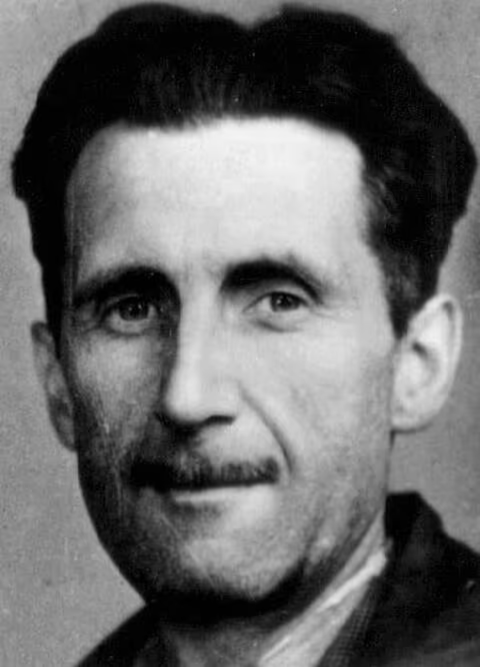
Quick Facts
Eric Arthur Blair
Pen Name: George Orwell
Born: 25 June 1903
Died: 21 January 1950
Nationality: British
Genres: Science Fiction, Satire, Essay, Literary Criticism
Notable Works: Nineteen Eighty-Four, Animal Farm, Homage to Catalonia, Down and Out in Paris and London, Politics and the English Language
👶 Early Life and Education
George Orwell was born Eric Arthur Blair on June 25, 1903, in Motihari, Bengal, British India. His father, Richard Walmesley Blair, was a minor official in the Indian Civil Service's Opium Department. His mother, Ida Mabel Blair, brought him to England in 1904, where he grew up in Henley-on-Thames, Oxfordshire. He had an older sister, Marjorie, and a younger sister, Avril.
At age eight, Blair was sent to St Cyprian's preparatory school in Eastbourne, an experience he later described in the autobiographical essay Such, Such Were the Joys. He won scholarships to both Wellington and Eton College, where one of his teachers was the novelist Aldous Huxley. Rather than proceeding to university, Blair joined the Indian Imperial Police in Burma in 1922, serving for five years before resigning in 1927, disillusioned with imperialism—an experience he drew upon in his novel Burmese Days (1934) and his celebrated essay Shooting an Elephant.
📖 Career and Literary Contributions
After returning to England, Blair spent years living among the poor in London and Paris, working as a dishwasher, tutor, and bookshop assistant. These experiences fueled his first book, Down and Out in Paris and London (1933), published under his new pen name, George Orwell—derived from the River Orwell in Suffolk.
In 1936, publisher Victor Gollancz commissioned Orwell to investigate conditions among unemployed workers in northern England, resulting in The Road to Wigan Pier (1937). That same year, Orwell traveled to Spain to fight against fascism in the Spanish Civil War, joining the POUM militia on the Aragon front. He was shot through the throat by a sniper in May 1937 but survived. His account of the war, Homage to Catalonia (1938), documented both the fighting and the suppression of revolutionary groups by Stalinist forces—a betrayal that cemented his opposition to totalitarianism.
During World War II, Orwell worked as a talks producer at the BBC Eastern Service (1941–1943) before becoming literary editor of Tribune, where he wrote his popular "As I Please" column. In 1945, he published the allegorical novella Animal Farm, a satirical fable of the Russian Revolution that brought him international fame and financial security for the first time.
His masterwork, Nineteen Eighty-Four (1949), depicted a totalitarian surveillance state ruled by Big Brother. The novel introduced concepts that have become part of everyday language: Big Brother, thought police, Room 101, doublethink, thoughtcrime, Newspeak, and cold war. The adjective "Orwellian" describes a situation, idea, or societal condition that is destructive to the welfare of a free and open society.
🌿 Writing Style
Orwell championed clarity above all else, famously declaring that "good prose should be transparent, like a window pane." In his essay Politics and the English Language (1946), he laid out six rules for effective writing: never use a metaphor you are used to seeing in print; never use a long word where a short one will do; if it is possible to cut a word out, always cut it out; never use the passive where you can use the active; never use a foreign phrase or jargon word if you can think of an everyday English equivalent; and break any of these rules sooner than say anything outright barbarous.
His prose is direct, concrete, and deceptively simple. He believed that political language was designed "to make lies sound truthful and murder respectable, and to give an appearance of solidity to pure wind." His commitment to honest, plain English set a standard that journalists and essayists still aspire to.
✒️ Notable Works
- Animal Farm (1945) — An allegorical novella satirizing the events leading to the Russian Revolution and the Stalinist era, told through a farmyard fable.
- Nineteen Eighty-Four (1949) — A dystopian novel depicting a totalitarian society under perpetual surveillance, exploring themes of truth, freedom, and language.
- Shooting an Elephant (1936) — A powerful essay about imperialism and moral conflict, drawn from his time as a police officer in Burma.
- Politics and the English Language (1946) — A landmark essay on the relationship between political corruption and the degradation of language.
- Homage to Catalonia (1938) — A personal account of fighting in the Spanish Civil War and witnessing Stalinist betrayal of the revolution.
❤️ Personal Life
Orwell married Eileen O’Shaughnessy, an Oxford-educated psychologist and poet, on June 9, 1936. Eileen was a vital collaborator—typing manuscripts, offering editorial criticism, and managing their household through years of poverty. Together they traveled to Spain, where Eileen worked at the POUM headquarters in Barcelona while Orwell fought at the front. In June 1944, they adopted a three-week-old boy they named Richard Horatio Blair.
Tragically, Eileen died on March 29, 1945, during a hysterectomy operation, at age 39. Orwell was devastated. On October 13, 1949, just three months before his own death, he married Sonia Brownell, an editorial assistant at Horizon magazine, in a ceremony at his hospital bedside.
✨ Death and Legacy
Orwell suffered from tuberculosis for much of his adult life, a condition worsened by the bullet wound to his throat in Spain and the damp climate of the Scottish island of Jura, where he wrote Nineteen Eighty-Four. He died on January 21, 1950, at University College Hospital in London, at the age of 46. He was buried in All Saints’ churchyard, Sutton Courtenay, Oxfordshire, under his birth name, Eric Arthur Blair.
Orwell’s influence on political thought, language, and literature is immeasurable. Animal Farm and Nineteen Eighty-Four remain among the most widely read and frequently assigned books in schools worldwide. The Orwell Prize, established in 1993, is Britain’s most prestigious award for political writing. His essays—particularly Politics and the English Language and Why I Write—continue to be essential reading for writers and journalists. We feature Orwell in our Science Fiction Study Guide and collection of Dystopian Stories.
⭐ Interesting Facts
- Orwell chose his pen name from the River Orwell in Suffolk, a place he loved. He considered other names including "P. S. Burton" and "H. Lewis Allways."
- He was shot through the throat by a fascist sniper in Spain in 1937 and temporarily lost his voice. He later wrote that the experience was "very interesting" and that his first thought was "annoyance at being put out of action."
- His six rules for writing from Politics and the English Language are still taught in journalism and English classes around the world.
- Words and phrases Orwell introduced to popular culture include: Big Brother, thought police, Room 101, doublethink, thoughtcrime, Newspeak, cold war, and Orwellian.
We find these Orwell quotes very compelling:
"To see what is in front of one’s nose needs a constant struggle."
"Who controls the past controls the future. Who controls the present controls the past."
"Doublethink means the power of holding two contradictory beliefs in one’s mind simultaneously, and accepting both of them."