The Cask of Amontillado
by Edgar Allan Poe
This story was included in Poe's collection, Tales of Mystery and Imagination, illustrated by Harry Clarke (1919). The story was first published in Godey's Lady Book in the November 1846 edition -- the most popular periodical in America at the time. It is often read by students in middle and high school. Readers: note that a "pipe" in the text below is a unit of measurement, equivalent to about 130 gallons. This story is featured in our collection of Halloween Stories and The Unreliable Narrator.
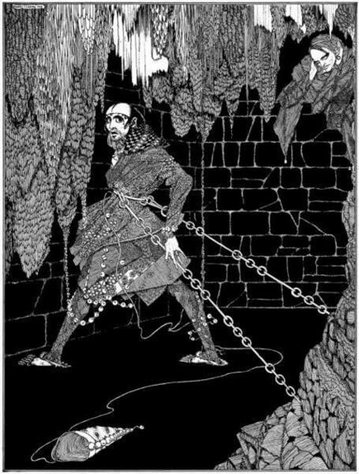
THE thousand injuries of Fortunato I had borne as I best could, but when he ventured upon insult I vowed revenge. You, who so well know the nature of my soul, will not suppose, however, that I gave utterance to a threat. At length I would be avenged; this was a point definitely, settled --but the very definitiveness with which it was resolved precluded the idea of risk. I must not only punish but punish with impunity. A wrong is unredressed when retribution overtakes its redresser. It is equally unredressed when the avenger fails to make himself felt as such to him who has done the wrong.
It must be understood that neither by word nor deed had I given Fortunato cause to doubt my good will. I continued, as was my wont, to smile in his face, and he did not perceive that my smile now was at the thought of his immolation.
He had a weak point --this Fortunato --although in other regards he was a man to be respected and even feared. He prided himself on his connoisseurship in wine. Few Italians have the true virtuoso spirit. For the most part their enthusiasm is adopted to suit the time and opportunity, to practise imposture upon the British and Austrian millionaires. In painting and gemmary, Fortunato, like his countrymen, was a quack, but in the matter of old wines he was sincere. In this respect I did not differ from him materially; --I was skilful in the Italian vintages myself, and bought largely whenever I could.
It was about dusk, one evening during the supreme madness of the carnival season, that I encountered my friend. He accosted me with excessive warmth, for he had been drinking much. The man wore motley. He had on a tight-fitting parti-striped dress, and his head was surmounted by the conical cap and bells. I was so pleased to see him that I thought I should never have done wringing his hand.
I said to him --"My dear Fortunato, you are luckily met. How remarkably well you are looking to-day. But I have received a pipe of what passes for Amontillado, and I have my doubts."
"How?" said he. "Amontillado, A pipe? Impossible! And in the middle of the carnival!"
"I have my doubts," I replied; "and I was silly enough to pay the full Amontillado price without consulting you in the matter. You were not to be found, and I was fearful of losing a bargain."
"Amontillado!"
"I have my doubts."
"Amontillado!"
"And I must satisfy them."
"Amontillado!"
"As you are engaged, I am on my way to Luchresi. If any one has a critical turn it is he. He will tell me --"
"Luchresi cannot tell Amontillado from Sherry."
"And yet some fools will have it that his taste is a match for your own.
"Come, let us go."
"Whither?"
"To your vaults."
"My friend, no; I will not impose upon your good nature. I perceive you have an engagement. Luchresi--"
"I have no engagement; --come."
"My friend, no. It is not the engagement, but the severe cold with which I perceive you are afflicted. The vaults are insufferably damp. They are encrusted with nitre."
"Let us go, nevertheless. The cold is merely nothing. Amontillado! You have been imposed upon. And as for Luchresi, he cannot distinguish Sherry from Amontillado."
Thus speaking, Fortunato possessed himself of my arm; and putting on a mask of black silk and drawing a roquelaire closely about my person, I suffered him to hurry me to my palazzo.
There were no attendants at home; they had absconded to make merry in honour of the time. I had told them that I should not return until the morning, and had given them explicit orders not to stir from the house. These orders were sufficient, I well knew, to insure their immediate disappearance, one and all, as soon as my back was turned.
I took from their sconces two flambeaux, and giving one to Fortunato, bowed him through several suites of rooms to the archway that led into the vaults. I passed down a long and winding staircase, requesting him to be cautious as he followed. We came at length to the foot of the descent, and stood together upon the damp ground of the catacombs of the Montresors.
The gait of my friend was unsteady, and the bells upon his cap jingled as he strode.
"The pipe," he said.
"It is farther on," said I; "but observe the white web-work which gleams from these cavern walls."
He turned towards me, and looked into my eyes with two filmy orbs that distilled the rheum of intoxication.
"Nitre?" he asked, at length.
"Nitre," I replied. "How long have you had that cough?"
"Ugh! ugh! ugh! --ugh! ugh! ugh! --ugh! ugh! ugh! --ugh! ugh! ugh! --ugh! ugh! ugh!"
My poor friend found it impossible to reply for many minutes.
"It is nothing," he said, at last.
"Come," I said, with decision, "we will go back; your health is precious. You are rich, respected, admired, beloved; you are happy, as once I was. You are a man to be missed. For me it is no matter. We will go back; you will be ill, and I cannot be responsible. Besides, there is Luchresi --"
"Enough," he said; "the cough's a mere nothing; it will not kill me. I shall not die of a cough."
"True --true," I replied; "and, indeed, I had no intention of alarming you unnecessarily --but you should use all proper caution. A draught of this Medoc will defend us from the damps.
Here I knocked off the neck of a bottle which I drew from a long row of its fellows that lay upon the mould.
"Drink," I said, presenting him the wine. He raised it to his lips with a leer. He paused and nodded to me familiarly, while his bells jingled.
"I drink," he said, "to the buried that repose around us."
"And I to your long life."
He again took my arm, and we proceeded.
"These vaults," he said, "are extensive."
"The Montresors," I replied, "were a great and numerous family."
"I forget your arms."
"A huge human foot d'or, in a field azure; the foot crushes a serpent rampant whose fangs are imbedded in the heel."
"And the motto?"
"Nemo me impune lacessit."
"Good!" he said.
The wine sparkled in his eyes and the bells jingled. My own fancy grew warm with the Medoc. We had passed through long walls of piled skeletons, with casks and puncheons intermingling, into the inmost recesses of the catacombs. I paused again, and this time I made bold to seize Fortunato by an arm above the elbow.
"The nitre!" I said; "see, it increases. It hangs like moss upon the vaults. We are below the river's bed. The drops of moisture trickle among the bones. Come, we will go back ere it is too late. Your cough --"
"It is nothing," he said; "let us go on. But first, another draught of the Medoc."
I broke and reached him a flagon of De Grave. He emptied it at a breath. His eyes flashed with a fierce light. He laughed and threw the bottle upwards with a gesticulation I did not understand.
I looked at him in surprise. He repeated the movement --a grotesque one.
"You do not comprehend?" he said.
"Not I," I replied.
"Then you are not of the brotherhood."
"How?"
"You are not of the masons."
"Yes, yes," I said; "yes, yes."
"You? Impossible! A mason?"
"A mason," I replied.
"A sign," he said, "a sign."
"It is this," I answered, producing from beneath the folds of my roquelaire a trowel.
"You jest," he exclaimed, recoiling a few paces. "But let us proceed to the Amontillado."
"Be it so," I said, replacing the tool beneath the cloak and again offering him my arm. He leaned upon it heavily. We continued our route in search of the Amontillado. We passed through a range of low arches, descended, passed on, and descending again, arrived at a deep crypt, in which the foulness of the air caused our flambeaux rather to glow than flame.
At the most remote end of the crypt there appeared another less spacious. Its walls had been lined with human remains, piled to the vault overhead, in the fashion of the great catacombs of Paris. Three sides of this interior crypt were still ornamented in this manner. From the fourth side the bones had been thrown down, and lay promiscuously upon the earth, forming at one point a mound of some size. Within the wall thus exposed by the displacing of the bones, we perceived a still interior crypt or recess, in depth about four feet, in width three, in height six or seven. It seemed to have been constructed for no especial use within itself, but formed merely the interval between two of the colossal supports of the roof of the catacombs, and was backed by one of their circumscribing walls of solid granite.
It was in vain that Fortunato, uplifting his dull torch, endeavoured to pry into the depth of the recess. Its termination the feeble light did not enable us to see.
"Proceed," I said; "herein is the Amontillado. As for Luchresi --"
"He is an ignoramus," interrupted my friend, as he stepped unsteadily forward, while I followed immediately at his heels. In an instant he had reached the extremity of the niche, and finding his progress arrested by the rock, stood stupidly bewildered. A moment more and I had fettered him to the granite. In its surface were two iron staples, distant from each other about two feet, horizontally. From one of these depended a short chain, from the other a padlock. Throwing the links about his waist, it was but the work of a few seconds to secure it. He was too much astounded to resist. Withdrawing the key I stepped back from the recess.
"Pass your hand," I said, "over the wall; you cannot help feeling the nitre. Indeed, it is very damp. Once more let me implore you to return. No? Then I must positively leave you. But I must first render you all the little attentions in my power."
"The Amontillado!" ejaculated my friend, not yet recovered from his astonishment.
"True," I replied; "the Amontillado."
As I said these words I busied myself among the pile of bones of which I have before spoken. Throwing them aside, I soon uncovered a quantity of building stone and mortar. With these materials and with the aid of my trowel, I began vigorously to wall up the entrance of the niche.
I had scarcely laid the first tier of the masonry when I discovered that the intoxication of Fortunato had in a great measure worn off. The earliest indication I had of this was a low moaning cry from the depth of the recess. It was not the cry of a drunken man. There was then a long and obstinate silence. I laid the second tier, and the third, and the fourth; and then I heard the furious vibrations of the chain. The noise lasted for several minutes, during which, that I might hearken to it with the more satisfaction, I ceased my labours and sat down upon the bones. When at last the clanking subsided, I resumed the trowel, and finished without interruption the fifth, the sixth, and the seventh tier. The wall was now nearly upon a level with my breast. I again paused, and holding the flambeaux over the mason-work, threw a few feeble rays upon the figure within.
A succession of loud and shrill screams, bursting suddenly from the throat of the chained form, seemed to thrust me violently back. For a brief moment I hesitated, I trembled. Unsheathing my rapier, I began to grope with it about the recess; but the thought of an instant reassured me. I placed my hand upon the solid fabric of the catacombs, and felt satisfied. I reapproached the wall; I replied to the yells of him who clamoured. I re-echoed, I aided, I surpassed them in volume and in strength. I did this, and the clamourer grew still.
It was now midnight, and my task was drawing to a close. I had completed the eighth, the ninth and the tenth tier. I had finished a portion of the last and the eleventh; there remained but a single stone to be fitted and plastered in. I struggled with its weight; I placed it partially in its destined position. But now there came from out the niche a low laugh that erected the hairs upon my head. It was succeeded by a sad voice, which I had difficulty in recognizing as that of the noble Fortunato. The voice said--
"Ha! ha! ha! --he! he! he! --a very good joke, indeed --an excellent jest. We will have many a rich laugh about it at the palazzo --he! he! he! --over our wine --he! he! he!"
"The Amontillado!" I said.
"He! he! he! --he! he! he! --yes, the Amontillado. But is it not getting late? Will not they be awaiting us at the palazzo, the Lady Fortunato and the rest? Let us be gone."
"Yes," I said, "let us be gone."
"For the love of God, Montresor!"
"Yes," I said, "for the love of God!"
But to these words I hearkened in vain for a reply. I grew impatient. I called aloud --
"Fortunato!"
No answer. I called again --
"Fortunato!"
No answer still. I thrust a torch through the remaining aperture and let it fall within. There came forth in return only a jingling of the bells. My heart grew sick; it was the dampness of the catacombs that made it so. I hastened to make an end of my labour. I forced the last stone into its position; I plastered it up. Against the new masonry I re-erected the old rampart of bones. For the half of a century no mortal has disturbed them. In pace requiescat!
THE END
Featured in our collection of Halloween Stories and Short Stories for Middle School II
Readers who enjoyed this short story may also be interested in The Black Cat and The Tell-Tale Heart.
Frequently Asked Questions about The Cask of Amontillado
What is "The Cask of Amontillado" about?
The Cask of Amontillado tells the story of Montresor, an Italian nobleman who lures his acquaintance Fortunato into the family catacombs under the pretense of authenticating a rare cask of Amontillado sherry. Set during carnival season, Montresor exploits Fortunato's pride as a wine connoisseur and his drunken state to guide him deeper underground. Once in the farthest recess of the vaults, Montresor chains Fortunato to the wall and entombs him alive behind a brick wall. The story is narrated by Montresor himself, apparently fifty years after the crime, making it both a confession and a chilling demonstration of premeditated murder carried out with impunity.
What are the main themes of "The Cask of Amontillado"?
The central theme is revenge — specifically, revenge pursued with cold, methodical calculation rather than impulsive rage. Montresor states his conditions at the outset: he must punish "with impunity" and make himself "felt as such" to the wrongdoer. Pride drives both characters — Montresor's wounded honor demands satisfaction, while Fortunato's vanity about his wine expertise makes him easy prey. The story also explores deception and betrayal, as Montresor weaponizes friendship and hospitality to commit murder. Finally, justice and its absence haunts the narrative: the "thousand injuries" are never specified, leaving readers to question whether Montresor's punishment bears any proportion to Fortunato's alleged offenses.
Why does Montresor kill Fortunato in "The Cask of Amontillado"?
Montresor claims that Fortunato has inflicted "a thousand injuries" upon him and then "ventured upon insult," which pushed him to vow revenge. However, deliberately never reveals what these injuries or the final insult actually were. This ambiguity is central to the story's horror — readers cannot determine whether Montresor's grievance is legitimate or the product of a delusional mind. What is clear is that Montresor's response is wildly disproportionate: he murders a man and entombs him alive. The vagueness of motive makes Montresor either an obsessive avenger consumed by perceived slights or a calculating psychopath who has rationalized murder as justice.
What literary devices does Poe use in "The Cask of Amontillado"?
employs an extraordinary density of literary devices in this story. Dramatic irony pervades the narrative, as readers know Montresor's murderous intent while Fortunato remains oblivious. Verbal irony appears in nearly every exchange — Montresor toasts "to your long life" while planning Fortunato's death, and repeatedly urges him to turn back out of feigned concern for his health. Foreshadowing operates through the catacombs setting, the Montresor coat of arms (a foot crushing a serpent), and the family motto. Symbolism is layered throughout: Fortunato's jester costume, the descent into the vaults mirroring a descent into hell, and the trowel as both literal tool and dark pun. Poe also uses a first-person unreliable narrator to create psychological tension, as everything is filtered through Montresor's self-justifying perspective.
What is the irony in "The Cask of Amontillado"?
Irony operates on multiple levels throughout the story. The most pervasive is dramatic irony: readers understand Montresor's deadly plan from the opening paragraph, while Fortunato walks willingly to his death. Verbal irony fills their dialogue — Montresor's repeated concern for Fortunato's cough ("your health is precious") masks his real intention, and his toast "to your long life" is grimly sardonic. The names themselves carry situational irony: "Fortunato" means "the fortunate one" in Italian, yet he is anything but fortunate; Montresor's name suggests "my treasure," and his treasure is revenge. Even Montresor's claim to be "a mason" is ironic — Fortunato means a Freemason, but Montresor means a literal stonemason who will wall him in. The entire carnival setting provides a backdrop of celebration and freedom that contrasts with entombment and death.
What does "Nemo me impune lacessit" mean in "The Cask of Amontillado"?
"Nemo me impune lacessit" is Latin for "No one attacks me with impunity" (or "No one provokes me unpunished"). It is the motto on the Montresor family coat of arms, which also features a golden foot crushing a serpent whose fangs are embedded in the heel. The motto functions as both foreshadowing and character revelation — it tells Fortunato (and the reader) exactly what kind of family the Montresors are and what Montresor intends to do, yet Fortunato responds only with "Good!" The phrase is historically the motto of the Scottish Crown and the Order of the Thistle, lending the Montresor family an aristocratic severity. It encapsulates the story's driving principle: Montresor believes any perceived offense demands absolute retribution.
What does the Amontillado symbolize in the story?
The Amontillado operates as a multifaceted symbol. On the surface, it is the bait that lures Fortunato underground — the rare sherry represents the irresistible temptation that exploits his vanity. On a deeper level, the Amontillado functions as an extended metaphor: just as a cask seals wine inside, the crypt ultimately seals Fortunato inside a stone vault. The wine itself never existed — it is a fiction created by Montresor, mirroring the way his stated grievances may also be fabrications or exaggerations. The pursuit of the Amontillado also symbolizes obsessive desire — Fortunato's consuming need to prove his expertise blinds him to every warning sign, just as Montresor's consuming need for revenge blinds him to the moral horror of his actions.
Is Montresor an unreliable narrator?
Montresor is widely considered one of the most significant unreliable narrators in American literature. He claims Fortunato inflicted "a thousand injuries" but never identifies a single one, and the final "insult" that supposedly triggered his revenge is equally unspecified. He appears to be telling the story fifty years after the murder — the closing line reveals that Fortunato's bones have remained undisturbed "for the half of a century" — yet he shows no remorse. His narration is suspiciously calculated, more like a performance than a confession. Readers must decide whether Montresor is a wronged aristocrat who executed justified vengeance, or a delusional and possibly insane murderer who invented grievances to rationalize an atrocity. This interpretive ambiguity, characteristic of 's first-person narratives in stories like The Tell-Tale Heart and The Black Cat, is central to the story's lasting power.
What is the setting of "The Cask of Amontillado"?
The story takes place in an unnamed Italian city during carnival season, probably in the late 18th or early 19th century. The action moves from the festive streets above to the Montresor family catacombs below — an underground network of vaults that serves as both wine cellar and burial ground. The contrast between these two settings is crucial: carnival represents freedom, revelry, and disguise, while the catacombs represent confinement, death, and revelation. As Montresor and Fortunato descend, the passages grow narrower, damper, and more oppressive, lined with human bones and encrusted with niter (potassium nitrate). This progressive descent mirrors both a physical and symbolic journey from life to death, from the light of the streets to the darkness of the tomb. uses the claustrophobic setting to build unbearable suspense — a technique he refined across stories like The Pit and the Pendulum and The Premature Burial.
When was "The Cask of Amontillado" written and why is it considered one of Poe's best stories?
The Cask of Amontillado was first published in November 1846 in Godey's Lady's Book, one of the most widely circulated American magazines of the era. wrote it during a turbulent period in his life, and some scholars believe the story reflects real feuds within the New York literary scene. It has been called Poe's most perfect short story because it exemplifies his theory that every element in a tale should contribute to a single, unified effect — in this case, dread. Every detail, from Fortunato's jester bells to the damp nitre on the walls, tightens the story's grip. Unlike longer Poe tales such as The Fall of the House of Usher, the narrative is ruthlessly compressed — no subplot, no digression — creating an intensity that has made it a staple of American literature classrooms for over 175 years.
Save stories, build your reading list, and access all study tools — completely free.
Save The Cask of Amontillado to your library — it's free!Need help with The Cask of Amontillado?
Study tools to help with homework, prepare for quizzes, and deepen your understanding.
Flashcards → | Vocabulary → | Study Guide →