Vanka
by Anton Chekhov
Vanka is one of many stories with a child-family separation theme. When Anton was fifteen he was separated from his own family when his father fled creditors and took his family to Moscow. Chekhov stayed behind to finish school, working to pay his own tuition and sending extra money to his family when he could. The trials of family seperation became a recurring theme in Chekov's writing. Vanka was published on Christmas Day in 1886. It's an excellent story and we have also included it in our collection of Christmas Stories.
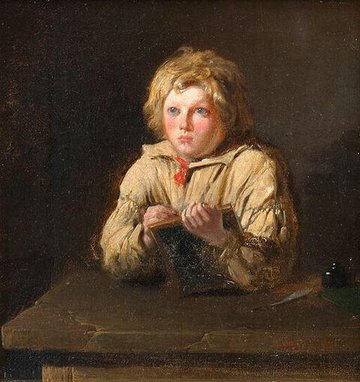
VANKA ZHUKOV, a boy of nine, who had been for three months apprenticed to Alyahin the shoemaker, was sitting up on Christmas Eve. Waiting till his master and mistress and their workmen had gone to the midnight service, he took out of his master's cupboard a bottle of ink and a pen with a rusty nib, and, spreading out a crumpled sheet of paper in front of him, began writing. Before forming the first letter he several times looked round fearfully at the door and the windows, stole a glance at the dark ikon, on both sides of which stretched shelves full of lasts, and heaved a broken sigh. The paper lay on the bench while he knelt before it.
"Dear grandfather, Konstantin Makaritch," he wrote, "I am writing you a letter. I wish you a happy Christmas, and all blessings from God Almighty. I have neither father nor mother, you are the only one left me."
Vanka raised his eyes to the dark ikon on which the light of his candle was reflected, and vividly recalled his grandfather, Konstantin Makaritch, who was night watchman to a family called Zhivarev. He was a thin but extraordinarily nimble and lively little old man of sixty-five, with an everlastingly laughing face and drunken eyes. By day he slept in the servants' kitchen, or made jokes with the cooks; at night, wrapped in an ample sheepskin, he walked round the grounds and tapped with his little mallet. Old Kashtanka and Eel, so-called on account of his dark colour and his long body like a weasel's, followed him with hanging heads. This Eel was exceptionally polite and affectionate, and looked with equal kindness on strangers and his own masters, but had not a very good reputation. Under his politeness and meekness was hidden the most Jesuitical cunning. No one knew better how to creep up on occasion and snap at one's legs, to slip into the store-room, or steal a hen from a peasant. His hind legs had been nearly pulled off more than once, twice he had been hanged, every week he was thrashed till he was half dead, but he always revived.
At this moment grandfather was, no doubt, standing at the gate, screwing up his eyes at the red windows of the church, stamping with his high felt boots, and joking with the servants. His little mallet was hanging on his belt. He was clasping his hands, shrugging with the cold, and, with an aged chuckle, pinching first the housemaid, then the cook.
"How about a pinch of snuff?" he was saying, offering the women his snuff-box.
The women would take a sniff and sneeze. Grandfather would be indescribably delighted, go off into a merry chuckle, and cry:
"Tear it off, it has frozen on!"
They give the dogs a sniff of snuff too. Kashtanka sneezes, wriggles her head, and walks away offended. Eel does not sneeze, from politeness, but wags his tail. And the weather is glorious. The air is still, fresh, and transparent. The night is dark, but one can see the whole village with its white roofs and coils of smoke coming from the chimneys, the trees silvered with hoar frost, the snowdrifts. The whole sky spangled with gay twinkling stars, and the Milky Way is as distinct as though it had been washed and rubbed with snow for a holiday. . . .
Vanka sighed, dipped his pen, and went on writing:
"And yesterday I had a wigging. The master pulled me out into the yard by my hair, and whacked me with a boot-stretcher because I accidentally fell asleep while I was rocking their brat in the cradle. And a week ago the mistress told me to clean a herring, and I began from the tail end, and she took the herring and thrust its head in my face. The workmen laugh at me and send me to the tavern for vodka, and tell me to steal the master's cucumbers for them, and the master beats me with anything that comes to hand. And there is nothing to eat. In the morning they give me bread, for dinner, porridge, and in the evening, bread again; but as for tea, or soup, the master and mistress gobble it all up themselves. And I am put to sleep in the passage, and when their wretched brat cries I get no sleep at all, but have to rock the cradle. Dear grandfather, show the divine mercy, take me away from here, home to the village. It's more than I can bear. I bow down to your feet, and will pray to God for you for ever, take me away from here or I shall die."
Vanka's mouth worked, he rubbed his eyes with his black fist, and gave a sob.
"I will powder your snuff for you," he went on. "I will pray for you, and if I do anything you can thrash me like Sidor's goat. And if you think I've no job, then I will beg the steward for Christ's sake to let me clean his boots, or I'll go for a shepherd-boy instead of Fedka. Dear grandfather, it is more than I can bear, it's simply no life at all. I wanted to run away to the village, but I have no boots, and I am afraid of the frost. When I grow up big I will take care of you for this, and not let anyone annoy you, and when you die I will pray for the rest of your soul, just as for my mammy's.
Moscow is a big town. It's all gentlemen's houses, and there are lots of horses, but there are no sheep, and the dogs are not spiteful. The lads here don't go out with the star, and they don't let anyone go into the choir, and once I saw in a shop window fishing-hooks for sale, fitted ready with the line and for all sorts of fish, awfully good ones, there was even one hook that would hold a forty-pound sheat-fish. And I have seen shops where there are guns of all sorts, after the pattern of the master's guns at home, so that I shouldn't wonder if they are a hundred roubles each. . . . And in the butchers' shops there are grouse and woodcocks and fish and hares, but the shopmen don't say where they shoot them.
"Dear grandfather, when they have the Christmas tree at the big house, get me a gilt walnut, and put it away in the green trunk. Ask the young lady Olga Ignatyevna, say it's for Vanka."
Vanka gave a tremulous sigh, and again stared at the window. He remembered how his grandfather always went into the forest to get the Christmas tree for his master's family, and took his grandson with him. It was a merry time! Grandfather made a noise in his throat, the forest crackled with the frost, and looking at them Vanka chortled too. Before chopping down the Christmas tree, grandfather would smoke a pipe, slowly take a pinch of snuff, and laugh at frozen Vanka. . . . The young fir trees, covered with hoar frost, stood motionless, waiting to see which of them was to die. Wherever one looked, a hare flew like an arrow over the snowdrifts. . . . Grandfather could not refrain from shouting: "Hold him, hold him . . . hold him! Ah, the bob-tailed devil!"
When he had cut down the Christmas tree, grandfather used to drag it to the big house, and there set to work to decorate it. . . . The young lady, who was Vanka's favourite, Olga Ignatyevna, was the busiest of all. When Vanka's mother Pelageya was alive, and a servant in the big house, Olga Ignatyevna used to give him goodies, and having nothing better to do, taught him to read and write, to count up to a hundred, and even to dance a quadrille. When Pelageya died, Vanka had been transferred to the servants' kitchen to be with his grandfather, and from the kitchen to the shoemaker's in Moscow.
"Do come, dear grandfather," Vanka went on with his letter. "For Christ's sake, I beg you, take me away. Have pity on an unhappy orphan like me; here everyone knocks me about, and I am fearfully hungry; I can't tell you what misery it is, I am always crying. And the other day the master hit me on the head with a last, so that I fell down. My life is wretched, worse than any dog's. . . . I send greetings to Alyona, one-eyed Yegorka, and the coachman, and don't give my concertina to anyone. I remain, your grandson, Ivan Zhukov. Dear grandfather, do come."
Vanka folded the sheet of writing-paper twice, and put it into an envelope he had bought the day before for a kopeck. . . . After thinking a little, he dipped the pen and wrote the address:
To grandfather in the village.
Then he scratched his head, thought a little, and added: Konstantin Makaritch. Glad that he had not been prevented from writing, he put on his cap and, without putting on his little greatcoat, ran out into the street as he was in his shirt. . . .
The shopmen at the butcher's, whom he had questioned the day before, told him that letters were put in post-boxes, and from the boxes were carried about all over the earth in mailcarts with drunken drivers and ringing bells. Vanka ran to the nearest post-box, and thrust the precious letter in the slit. . . .
An hour later, lulled by sweet hopes, he was sound asleep. . . . He dreamed of the stove. On the stove was sitting his grandfather, swinging his bare legs, and reading the letter to the cooks. . . .
By the stove was Eel, wagging his tail.
This story is featured in Christmas Stories and our guide to Russian Writers.
Frequently Asked Questions about Vanka
What is the summary of "Vanka" by Anton Chekhov?
"Vanka" tells the story of nine-year-old orphan Vanka Zhukov, who has been apprenticed to the shoemaker Alyahin in Moscow. On Christmas Eve, while his master is away at church, Vanka secretly writes a desperate letter to his grandfather, Konstantin Makaritch, begging to be rescued from his miserable life of beatings, hunger, and exhaustion.
Between passages of the letter, weaves in Vanka's warm memories of village life — his grandfather as a night watchman, the beloved dogs Kashtanka and Eel, and cutting down Christmas trees. The story ends with devastating irony: Vanka addresses the letter simply "To grandfather in the village" with no proper address or stamp, ensuring it will never arrive. He falls asleep dreaming his grandfather is reading the letter aloud.
What are the main themes of "Vanka" by Chekhov?
The central themes of "Vanka" include childhood suffering and innocence, as nine-year-old Vanka endures beatings, starvation, and exploitation at the hands of his master Alyahin. The story also explores hope versus futility — Vanka pours his heart into a letter that will never reach his grandfather because he addresses it only "To grandfather in the village."
Other key themes include family separation and loneliness, the contrast between rural innocence and urban cruelty, and the powerlessness of children in a society that treats them as disposable labor. uses the ironic Christmas Eve setting to heighten the emotional impact of Vanka's isolation.
What is the irony in Chekhov's "Vanka"?
The most powerful irony in "Vanka" is the undeliverable letter. Vanka pours all his desperate hope into writing to his grandfather Konstantin Makaritch, but addresses the envelope only as "To grandfather in the village" — with no proper address, no surname, and no postage stamp. The letter will never arrive, yet Vanka falls asleep "lulled by sweet hopes," dreaming his grandfather is reading it aloud.
The Christmas Eve setting adds further irony: a holiday associated with joy, family, and salvation becomes the backdrop for a child's unanswered cry for help. never states the letter's fate directly — he trusts the reader to recognize the futility, making the ending more devastating through understatement rather than melodrama.
Who is Vanka Zhukov in Chekhov's story?
Vanka Zhukov (also called Ivan Zhukov) is the nine-year-old protagonist of 's story. He is an orphan whose mother, Pelageya, was a servant in a wealthy household before she died. After her death, Vanka was sent from his grandfather's care in the village to Moscow, where he was apprenticed to the shoemaker Alyahin.
Despite his suffering — being beaten with a boot-stretcher, struck on the head with a last, starved, and forced to rock the master's baby all night — Vanka retains a child's innocence and hope. He was taught to read and write by the young lady Olga Ignatyevna, which enables him to compose his heartbreaking letter. His naive belief that simply mailing a letter addressed "To grandfather in the village" will bring rescue reveals both his innocence and his desperation.
What literary devices does Chekhov use in "Vanka"?
Chekhov employs several literary devices in "Vanka." The epistolary form — framing the narrative around Vanka's letter — allows the reader direct access to the child's voice and emotions. Dramatic irony is central: the reader understands the letter addressed "To grandfather in the village" will never arrive, while Vanka does not.
Juxtaposition contrasts Vanka's warm, lyrical memories of village life — the starry sky, the Milky Way "as distinct as though it had been washed and rubbed with snow" — with the grim reality of his Moscow apprenticeship. also uses imagery extensively, from the frozen winter landscape to the dark ikon lit by candlelight. The Christmas Eve setting functions as situational irony, and the restrained, objective narrative voice is a hallmark of Chekhov's realism.
What is the significance of the letter in "Vanka"?
The letter in "Vanka" serves multiple purposes in the story. On the surface, it is Vanka's desperate plea to his grandfather Konstantin Makaritch to rescue him from his abusive apprenticeship. But symbolically, the letter represents hope itself — the child's belief that someone cares enough to save him.
The letter also functions as a narrative device that allows to reveal Vanka's character, his memories, and his suffering without relying on external narration. Most importantly, the improperly addressed letter — sent to "To grandfather in the village" with no stamp — embodies the story's central tragic irony. Vanka's hope is sincere but futile, and the letter becomes a symbol of the gap between a child's innocent faith and the indifferent adult world.
What is the setting of "Vanka" by Chekhov?
"Vanka" takes place on Christmas Eve, 1886, and shifts between two contrasting settings. The present setting is the shoemaker Alyahin's workshop in Moscow, where Vanka writes his letter by candlelight while his master is at the midnight church service. This setting is dark, oppressive, and isolating.
The remembered setting is Vanka's home village, associated with his grandfather Konstantin Makaritch and the Zhivarev estate. These memories are vivid and lyrical — starry skies, snow-covered roofs, the forest where they cut Christmas trees, and the warmth of the servants' kitchen. The contrast between city and village mirrors the contrast between Vanka's present misery and his lost happiness, making the rural world seem almost impossibly idyllic through the lens of a suffering child's memory.
How does "Vanka" reflect child labor in 19th-century Russia?
Chekhov's "Vanka" provides a window into the practice of child apprenticeship in late 19th-century Russia. Nine-year-old Vanka has been sent to Moscow to learn shoemaking under the master Alyahin — a common arrangement where orphans and children of the poor were placed with tradesmen, often with no legal protections or oversight.
Vanka's experience reflects the harsh realities of this system: he is beaten with a boot-stretcher and a last, fed only bread and porridge, denied sleep while forced to rock the master's baby, and bullied by older workmen who send him to steal cucumbers and fetch vodka. does not editorialize or preach — he simply presents Vanka's suffering through the child's own words, allowing the reader to draw conclusions about the systemic exploitation of vulnerable children in a society with no effective child welfare protections.
What is the ending of "Vanka" and what does it mean?
The ending of "Vanka" is among 's most poignant. After finishing his letter, Vanka addresses it "To grandfather in the village" and adds only the name "Konstantin Makaritch" — no village name, no district, no stamp. He runs to the nearest post-box and drops the letter in the slit.
An hour later, Vanka falls asleep "lulled by sweet hopes," dreaming that his grandfather is sitting on a stove reading the letter aloud while the dog Eel wags his tail. The ending is devastatingly ironic: Vanka's hope is entirely misplaced. The letter will never be delivered. Yet Chekhov ends not with despair but with the child's dream — a moment of peace that makes the reality even more heartbreaking. The open ending leaves Vanka's fate unresolved, forcing the reader to sit with the emotional weight of his situation.
Who is Konstantin Makaritch in "Vanka"?
Konstantin Makaritch is Vanka's grandfather and the only family the boy has left. He works as a night watchman for the Zhivarev family in the village, walking the grounds at night with a little mallet and accompanied by two dogs — Kashtanka and Eel.
Chekhov describes him as a "thin but extraordinarily nimble and lively little old man of sixty-five, with an everlastingly laughing face and drunken eyes." He jokes with the servants, offers the women snuff, and takes Vanka into the forest to cut Christmas trees. For Vanka, Konstantin Makaritch represents warmth, safety, and the lost world of the village. However, it was Konstantin who sent Vanka to Moscow in the first place, suggesting that even this loving grandfather may have lacked the means or will to keep the boy — adding another layer of complexity to Vanka's desperate plea.
Save stories, build your reading list, and access all study tools — completely free.
Save Vanka to your library — it's free!Need help with Vanka?
Study tools to help with homework, prepare for quizzes, and deepen your understanding.
Flashcards →