The Tell-Tale Heart
by Edgar Allan Poe
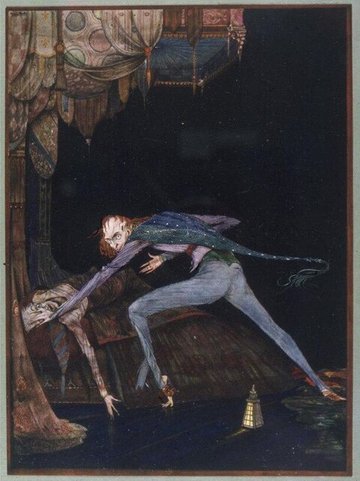
Illustrations for The Tell-Tale Heart were drawn by Harry Clarke, from Edgar Allan Poe's collection, Tales of Mystery and Imagination (1919). We feature it in our collection of Halloween Stories, Short Stories for Middle School II and The Unreliable Narrator.
TRUE!-NERVOUS--very, very dreadfully nervous I had been and am! but why will you say that I am mad? The disease had sharpened my senses--not destroyed--not dulled them. Above all was the sense of hearing acute. I heard all things in the heaven and in the earth. I heard many things in hell. How, then, am I mad? Hearken! and observe how healthily--how calmly I can tell you the whole story.
It is impossible to tell how first the idea entered my brain; but once conceived, it haunted me day and night. Object there was none. Passion there was none. I loved the old man. He had never wronged me. He had never given me insult. For his gold I had no desire. I think it was his eye! Yes, it was this! One of his eyes resembled that of a vulture--a pale blue eye, with a film over it. Whenever it fell upon me, my blood ran cold; and so by degrees--very gradually--I made up my mind to take the life of the old man, and thus rid myself of the eye forever.
Now this is the point. You fancy me mad. Madmen know nothing. But you should have seen me. You should have seen how wisely I proceeded--with what caution--with what foresight--with what dissimulation I went to work!
I was never kinder to the old man than during the whole week before I killed him. And every night, about midnight, I turned the latch of his door and opened it--oh, so gently! And then, when I had made an opening sufficient for my head, I put in a dark lantern, all closed, closed, so that no light shone out, and then I thrust in my head. Oh, you would have laughed to see how cunningly I thrust it in! I moved it slowly--very, very slowly, so that I might not disturb the old man's sleep. It took me an hour to place my whole head within the opening so far that I could see him as he lay upon his bed. Ha!--would a madman have been so wise as this? And then, when my head was well in the room, I undid the lantern cautiously--oh, so cautiously--cautiously (for the hinges creaked)--I undid it just so much that a single thin ray fell upon the vulture eye. And this I did for seven long nights--every night just at midnight--but I found the eye always closed; and so it was impossible to do the work; for it was not the old man who vexed me, but his Evil Eye. And every morning, when the day broke, I went boldly into the chamber, and spoke courageously to him, calling him by name in a hearty tone, and inquiring how he had passed the night. So you see he would have been a very profound old man, indeed, to suspect that every night, just at twelve, I looked in upon him while he slept.
Upon the eighth night I was more than usually cautious in opening the door. A watch's minute hand moves more quickly than did mine. Never before that night had I felt the extent of my own powers--of my sagacity. I could scarcely contain my feelings of triumph. To think that there I was, opening the door, little by little, and he not even to dream of my secret deeds or thoughts. I fairly chuckled at the idea; and perhaps he heard me; for he moved on the bed suddenly, as if startled. Now you may think that I drew back--but no. His room was as black as pitch with the thick darkness (for the shutters were close fastened, through fear of robbers), and so I knew that he could not see the opening of the door, and I kept pushing it on steadily, steadily.
I had my head in, and was about to open the lantern, when my thumb slipped upon the tin fastening, and the old man sprang up in bed, crying out: "Who's there?"
I kept quite still and said nothing. For a whole hour I did not move a muscle, and in the meantime I did not hear him lie down. He was still sitting up in the bed listening;--just as I have done, night after night, hearkening to the death watches in the wall.
Presently I heard a slight groan, and I knew it was the groan of mortal terror. It was not a groan of pain or grief--oh no!--it was the low stifled sound that arises from the bottom of the soul when overcharged with awe. I knew the sound well. Many a night, just at midnight, when all the world slept, it has welled up from my own bosom, deepening, with its dreadful echo, the terrors that distracted me. I say I knew it well. I knew what the old man felt, and pitied him, although I chuckled at heart. I knew that he had been lying awake ever since the first slight noise, when he had turned in the bed. His fears had been ever since growing upon him. He had been trying to fancy them causeless, but could not. He had been saying to himself: "It is nothing but the wind in the chimney--it is only a mouse crossing the floor," or "it is merely a cricket which has made a single chirp." Yes, he had been trying to comfort himself with these suppositions; but he had found all in vain. All in vain; because Death, in approaching him. had stalked with his black shadow before him, and enveloped the victim. And it was the mournful influence of the unperceived shadow that caused him to feel--although he neither saw nor heard--to feel the presence of my head within the room.
When I had waited a long time, very patiently, without hearing him lie down, I resolved to open a little--a very, very little crevice in the lantern. So I opened it--you cannot imagine how stealthily, stealthily--until, at length, a single dim ray, like the thread of the spider, shot from out the crevice and full upon the vulture eye.
It was open--wide, wide open--and I grew furious as I gazed upon it. I saw it with perfect distinctness--all a dull blue, with a hideous veil over it that chilled the very marrow in my bones; but I could see nothing else of the old man's face or person: for I had directed the ray, as if by instinct, precisely upon the damned spot.
And now--have I not told you that what you mistake for madness is but over-acuteness of the senses?--now, I say, there came to my ears a low, dull, quick sound, such as a watch makes when enveloped in cotton. I knew that sound well too. It was the beating of the old man's heart. It increased my fury, as the beating of a drum stimulates the soldier into courage.
But even yet I refrained and kept still. I scarcely breathed. I held the lantern motionless. I tried how steadily I could maintain the ray upon the eye. Meantime the hellish tattoo of the heart increased. It grew quicker and quicker and louder and louder every instant. The old man's terror must have been extreme! It grew louder, I say, louder every moment!--do you mark me well? I have told you that I am nervous: so I am. And now at the dead hour of night, amid the dreadful silence of that old house, so strange a noise as this excited me to uncontrollable terror. Yet, for some minutes longer I refrained and stood still. But the beating grew louder, louder! I thought the heart must burst. And now a new anxiety seized me--the sound would be heard by a neighbor! The old man's hour had come! With a loud yell, I threw open the lantern and leaped into the room. He shrieked once--once only. In an instant I dragged him to the floor, and pulled the heavy bed over him. I then smiled gaily, to find the deed so far done. But, for many minutes, the heart beat on with a muffled sound. This, however, did not vex me; it would not be heard through the wall. At length it ceased. The old man was dead. I removed the bed and examined the corpse. Yes, he was stone, stone dead. I placed my hand upon the heart and held it there many minutes. There was no pulsation. He was stone dead. His eye would trouble me no more.
If still you think me mad, you will think so no longer when I describe the wise precautions I took for the concealment of the body. The night waned, and I worked hastily, but in silence. First of all I dismembered the corpse. I cut off the head and the arms and the legs.
I then took up three planks from the flooring of the chamber, and deposited all between the scantlings. I then replaced the boards so cleverly, so cunningly, that no human eye--not even his--could have detected anything wrong. There was nothing to wash out--no stain of any kind--no blood-spot whatever. I had been too wary for that. A tub had caught all--ha! ha!
When I had made an end of these labors, it was four o'clock--still dark as midnight. As the bell sounded the hour, there came a knocking at the street door. I went down to open it with a light heart--for what had I now to fear? There entered three men, who introduced themselves, with perfect suavity, as officers of the police. A shriek had been heard by a neighbor during the night: suspicion of foul play had been aroused; information had been lodged at the police office, and they (the officers) had been deputed to search the premises.
I smiled--for what had I to fear? I bade the gentlemen welcome. The shriek, I said, was my own in a dream. The old man, I mentioned, was absent in the country. I took my visitors all over the house. I bade them search--search well. I led them, at length, to his chamber. I showed them his treasures, secure, undisturbed. In the enthusiasm of my confidence, I brought chairs into the room, and desired them here to rest from their fatigues, while I myself, in the wild audacity of my perfect triumph, placed my own seat upon the very spot beneath which reposed the corpse of the victim.
The officers were satisfied. My manner had convinced them. I was singularly at ease. They sat, and while I answered cheerily, they chatted familiar things. But, ere long, I felt myself getting pale and wished them gone. My head ached, and I fancied a ringing in my ears: but still they sat and still chatted. The ringing became more distinct:--it continued and became more distinct: I talked more freely to get rid of the feeling: but it continued and gained definiteness--until, at length, I found that the noise was not within my ears.
No doubt I now grew very pale,--but I talked more fluently, and with a heightened voice. Yet the sound increased--and what could I do? It was a low, dull, quick sound--much such a sound as a watch makes when enveloped in cotton. I gasped for breath--and yet the officers heard it not. I talked more quickly--more vehemently; but the noise steadily increased. Why would they not be gone? I paced the floor to and fro with heavy strides, as if excited to fury by the observation of the men--but the noise steadily increased. Oh, God; what could I do? I foamed--I raved--I swore! I swung the chair upon which I had been sitting, and grated it upon the boards, but the noise arose over all and continually increased. It grew louder--louder --louder! And still the men chatted pleasantly, and smiled. Was it possible they heard not? Almighty God!--no, no! They heard!--they suspected--they knew!--they were making a mockery of my horror!--this I thought, and this I think. But anything was better than this agony! Anything was more tolerable than this derision! I could bear those hypocritical smiles no longer! I felt that I must scream or die!--and now--again!--hark! louder! louder! louder!
"Villains!" I shrieked, "dissemble no more! I admit the deed!--tear up the planks!--here, here!--it is the beating of his hideous heart!"
This story is featured in our collection of Halloween Stories and Short Stories for Middle School II and The Unreliable Narrator.
Frequently Asked Questions about The Tell-Tale Heart
What is "The Tell-Tale Heart" by Edgar Allan Poe about?
"The Tell-Tale Heart" is a psychological horror story narrated by an unnamed murderer who insists throughout that he is perfectly sane. The narrator becomes obsessed with the pale blue, film-covered eye of the old man he lives with and decides to kill him — not out of anger, greed, or any rational motive, but solely to rid himself of the eye. After watching the old man sleep for seven consecutive nights, on the eighth night the narrator startles him awake, hears the frantic beating of the old man's heart, and smothers him under his own bed. He meticulously dismembers the corpse and conceals it beneath the floorboards. When police arrive — alerted by a neighbor who heard a shriek — the narrator is confident and at ease, seating the officers directly above the hidden body. But he gradually begins to hear a rhythmic thumping that grows unbearably loud, and, convinced the officers can hear it too and are mocking him, he snaps and confesses: "it is the beating of his hideous heart!"
What are the main themes of "The Tell-Tale Heart"?
The central themes of the story are guilt and conscience, madness versus sanity, and obsession. The narrator's insistence that he is sane — "how calmly I can tell you the whole story" — is itself the strongest evidence of his madness, creating a paradox that drives the entire narrative. His fixation on the old man's "vulture eye" illustrates how obsession can overwhelm reason: he admits he loved the old man and had no grievance, yet the eye alone compels him to murder. Most critically, the beating heart that the narrator hears after the murder represents the inescapable force of guilt. Whether the sound is a hallucination born of his conscience or a supernatural manifestation, it overpowers his careful logic and forces his confession. also explores self-deception — the narrator's meticulous planning, which he offers as proof of sanity, is precisely what reveals the depth of his derangement.
Why does the narrator kill the old man in "The Tell-Tale Heart"?
The narrator kills the old man because of his eye — a pale blue eye with a cloudy film over it that the narrator describes as resembling "that of a vulture." He is explicit that he had no rational motive: "Object there was none. Passion there was none. I loved the old man. He had never wronged me. He had never given me insult. For his gold I had no desire." The eye itself provokes an irrational, visceral horror — "whenever it fell upon me, my blood ran cold" — and the narrator convinces himself that destroying the eye requires destroying the man. This disconnect between loving the person but being unable to separate him from the thing he hates is central to the story's exploration of irrational obsession. Notably, the narrator can only carry out the murder when the eye is open; on the seven nights it remained closed, he found it "impossible to do the work."
Is the narrator of "The Tell-Tale Heart" insane?
This is one of the most debated questions in American literature. The narrator emphatically denies his madness — "why will you say that I am mad?" — and offers his calmness, methodical planning, and acute senses as proof of sanity. However, constructs the narrative so that every claim of rationality actually reinforces the reader's impression of insanity. The narrator murders a man he loves over an eye, watches him sleep for a week, hears the dead man's heart beating after death, and interprets the police officers' polite small talk as deliberate mockery. His heightened senses, which he attributes to a "disease" that sharpened rather than destroyed them, are consistent with paranoid delusion. The story's power lies in this ambiguity: the narrator is clearly delusional, yet his account is so precise and self-aware that readers must engage with the question rather than dismiss him outright.
What literary devices does Edgar Allan Poe use in "The Tell-Tale Heart"?
employs several powerful literary devices. The unreliable narrator is the story's structural foundation — the narrator's account is our only source of information, yet his perceptions are demonstrably distorted. Repetition builds mounting dread: phrases like "louder — louder — louder!" and "stone, stone dead" mimic the narrator's obsessive mind and accelerate the story's rhythm. Dramatic irony pervades the climax, as the narrator sits calmly above the hidden corpse, convinced of his triumph, while the reader knows his composure will shatter. Symbolism is central — the vulture eye and the beating heart carry layered meanings (see separate FAQ entries). Poe also uses auditory imagery to extraordinary effect: the heartbeat "like a watch enveloped in cotton," the "hellish tattoo" growing louder, and the death watches ticking in the wall all create a soundscape that traps the reader inside the narrator's paranoia. The story's compressed, breathless first-person monologue form — with its dashes, exclamation marks, and direct addresses to the reader — was revolutionary for 1843.
What does the old man's eye symbolize in "The Tell-Tale Heart"?
The old man's pale blue eye with its thin film has been interpreted as a symbol on multiple levels. Most commonly, it represents the narrator's projected guilt or inner evil — the "Evil Eye" he refers to, a concept rooted in superstition about a gaze that brings misfortune. The narrator cannot look at the eye without his "blood running cold," suggesting it reflects something intolerable within himself rather than any quality of the old man. The eye has also been read as a symbol of surveillance or judgment — an all-seeing observer that the narrator feels compelled to destroy because he cannot bear to be watched or known. Its resemblance to a vulture's eye associates it with death and predation, creating an irony in which the narrator, believing himself the stalker, feels stalked. Significantly, the narrator can distinguish the eye from the man — "it was not the old man who vexed me, but his Evil Eye" — yet cannot destroy one without the other, reflecting the impossibility of separating a person from the parts of them we fear.
What does the beating heart represent at the end of "The Tell-Tale Heart"?
The rhythmic thumping the narrator hears beneath the floorboards — which he identifies as "the beating of his hideous heart" — is the story's most powerful symbol. It most directly represents the narrator's guilty conscience, which he cannot silence no matter how carefully he has concealed the crime. The sound begins faintly during the police visit and grows unbearable, mirroring the way suppressed guilt intensifies over time. Whether the heartbeat is a psychological hallucination or something genuinely supernatural is left deliberately ambiguous by . The narrator first hears a similar beating during the murder itself — the old man's terrified heart — and its recurrence after death suggests his mind has trapped itself in a loop of its own making. The beating heart also functions as a kind of poetic justice: the narrator's "over-acuteness of the senses," which he boasts about as proof of sanity, becomes the very instrument of his undoing.
When was "The Tell-Tale Heart" first published?
"The Tell-Tale Heart" was first published in January 1843 in The Pioneer, a short-lived literary magazine edited by James Russell Lowell. wrote the story while living in Philadelphia, where he resided from 1838 to 1844 and produced some of his most celebrated works. The story was later reprinted in The Broadway Journal on August 23, 1845, when Poe had become its editor. At just over 2,000 words, it is one of the most compact and tightly constructed stories in the American literary canon. It has never been out of print and remains one of the most widely anthologized short stories in the English language, appearing in countless textbooks and collections since its first publication nearly two centuries ago.
How does "The Tell-Tale Heart" compare to Poe's other horror stories?
"The Tell-Tale Heart" shares thematic DNA with several of 's other works while remaining distinctive in its approach. The Black Cat is its closest companion piece — both feature a first-person narrator who murders someone he claims to love, hides the body behind a wall or floor, and is betrayed by a sound that reveals the crime. The Cask of Amontillado shares the unreliable first-person confession structure but inverts the outcome: Montresor succeeds in concealing his murder and feels no guilt. The Imp of the Perverse explicitly theorizes the self-destructive compulsion to confess that drives the narrator of "The Tell-Tale Heart." What distinguishes this story is its extreme compression and psychological intensity — there is no backstory, no setting description, no subplot, just a mind unraveling in real time.
What is the significance of sound in "The Tell-Tale Heart"?
Sound is the dominant sensory experience in the story, and uses it to chart the narrator's psychological disintegration. The narrator opens by boasting that his "disease had sharpened my senses — not destroyed — not dulled them" and that he "heard all things in the heaven and in the earth." This hyper-acute hearing becomes the thread connecting every major event. He listens to the old man's "death watches in the wall" during the week of surveillance. On the murder night, he hears the old man's heartbeat — "a low, dull, quick sound, such as a watch makes when enveloped in cotton" — and it drives him to attack. After the murder, the same sound returns during the police visit, growing from faint to deafening. The progression from silence to unbearable noise mirrors the narrator's journey from calculated control to total breakdown. Poe's repeated comparison of the heartbeat to a watch also ties sound to time, reinforcing the sense that the narrator is trapped in an inexorable countdown toward confession.
Save stories, build your reading list, and access all study tools — completely free.
Save The Tell-Tale Heart to your library — it's free!Need help with The Tell-Tale Heart?
Study tools to help with homework, prepare for quizzes, and deepen your understanding.
Flashcards → | Vocabulary → | Study Guide →