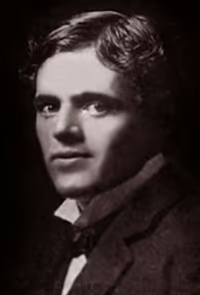
Quick Facts
John Griffith Chaney
Pen Name: Jack London
Born: Jan 12, 1876
Died: Nov 22, 1916
Nationality: American
Genres: Adventure, Naturalism, Realism
Notable Works: The Call of the Wild, White Fang, The Sea Wolf, Martin Eden, The Iron Heel
👶 Early Life and Background
Jack London (January 12, 1876 – November 22, 1916) was born John Griffith Chaney in San Francisco, California. His mother, Flora Wellman, was a spiritualist and music teacher; his biological father, astrologer William Chaney, abandoned the family before London's birth. Flora married Civil War veteran John London in 1876, who gave the boy his surname. The family moved several times around the San Francisco Bay Area, and young Jack grew up in working-class poverty in Oakland.
📚 Self-Education and Early Adventures
London was largely self-educated, devouring books at the Oakland Public Library under the guidance of librarian Ina Coolbrith (California's first poet laureate). At age 14, he left school to work in a cannery. By 15, he was an "oyster pirate" on San Francisco Bay, and later worked for the California Fish Patrol. At 17, he sailed to Japan aboard the sealing schooner Sophia Sutherland. He tramped across the United States as a hobo in 1894, was jailed for vagrancy for thirty days in the Erie County Penitentiary in New York, and joined the Klondike Gold Rush in 1897—experiences that would fuel his greatest fiction.
📖 Literary Career and Breakthrough
London began publishing stories in the Overland Monthly in 1899. His first collection, The Son of the Wolf (1900), established him as a powerful voice of the American frontier. His masterpiece The Call of the Wild (1903) made him internationally famous overnight. He followed it with White Fang (1906), The Sea-Wolf (1904), and Martin Eden (1909). London was one of the first American authors to become an international celebrity and earn a large fortune from writing, completing over 50 books in just 17 years.
🌿 Writing Style and Themes
London's writing is characterized by vivid, muscular prose, intense physical action, and unflinching naturalism. Influenced by Darwin, Spencer, Marx, and Nietzsche, his work explores the primal struggle for survival, the tension between civilization and the wild, and the resilience of the human (and animal) spirit. His Klondike stories—especially To Build a Fire—are masterclasses in naturalist fiction, depicting humanity's smallness against an indifferent natural world. He was also a pioneer of science fiction and dystopian fiction, with The Iron Heel (1908) predicting fascist tyranny a decade before its rise in Europe.
✒️ Notable Works
London's most enduring works include The Call of the Wild (1903), White Fang (1906), The Sea-Wolf (1904), Martin Eden (1909), and the autobiographical memoir John Barleycorn (1913). His most famous short story, To Build a Fire (1908), is one of the most widely anthologized American stories and a staple of school curricula. Other celebrated stories include The Law of Life, Love of Life (a favorite of Lenin's), The Mexican, and The Story of Keesh. His best-selling book during his lifetime was Burning Daylight (1910).
❤️ Personal Life
London married Bessie Maddern in 1900; they had two daughters, Joan and Bess ("Becky"), before divorcing in 1904. He married Charmian Kittredge the same year, and they remained together until his death. In 1905, he purchased a ranch in Glen Ellen, Sonoma County, California, where he attempted to build his dream estate, "Wolf House"—which burned down in 1913 just before completion, devastating him. London was an outspoken socialist and war correspondent who covered the Russo-Japanese War (1904) and the Mexican Revolution (1914).
✨ Death and Legacy
London died on November 22, 1916, at age 40, at his ranch in Glen Ellen. His death certificate lists the cause as uremia following acute renal colic; most modern biographers believe it was uremia aggravated by an accidental morphine overdose, though rumors of suicide persisted for decades. Despite his short life, London produced an extraordinary body of work—over 200 short stories and 20 novels—that continues to be read worldwide. His works have been translated into more languages than those of any other American author of his era, and The Call of the Wild remains one of the most widely read American novels. The Jack London State Historic Park in Glen Ellen preserves his ranch and legacy.
⭐ Interesting Facts
London was one of the highest-paid authors of his time, earning the equivalent of millions in today's dollars. He wrote 1,000 words every morning without fail. He was accused of plagiarism multiple times—partly because he bought story plots from a young Sinclair Lewis and used newspaper incidents as material. Leon Trotsky read The Iron Heel while in prison, and Vladimir Lenin had Love of Life read aloud to him on his deathbed.
"Life is not always a matter of holding good cards, but sometimes, playing a poor hand well."
"The most beautiful stories always start with wreckage."
"A bone to the dog is not charity. Charity is the bone shared with the dog, when you are just as hungry as the dog."
Frequently Asked Questions about Jack London
Where can I find study guides for Jack London's stories?
We offer free interactive study guides for the following Jack London stories:
- A Piece of Steak — comprehension questions, vocabulary review, and discussion prompts
- That Spot — comprehension questions, vocabulary review, and discussion prompts
- The Law of Life — comprehension questions, vocabulary review, and discussion prompts
- The Story of Keesh — comprehension questions, vocabulary review, and discussion prompts
- To Build a Fire — comprehension questions, vocabulary review, and discussion prompts