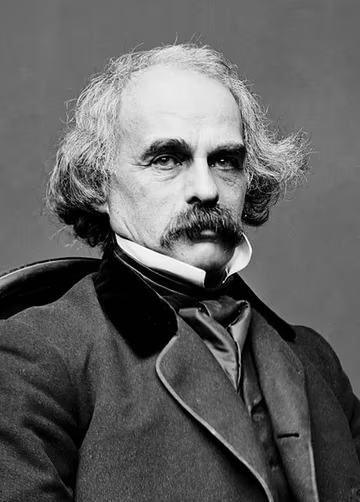
Quick Facts
Nathaniel Hawthorne
Born: July 4, 1804
Died: May 19, 1864
Nationality: American
Genres: Dark Romanticism, Gothic, Romanticism, Historical Fiction
Notable Works: The Scarlet Letter, The House of the Seven Gables, The Blithedale Romance, Young Goodman Brown, The Birthmark
👶 Early Life and Education
Nathaniel Hawthorne was born on July 4, 1804, in Salem, Massachusetts, into a family steeped in New England Puritan history. His great-great-grandfather, William Hathorne, was a magistrate who ordered the public whipping of a Quaker woman. His great-great-grandfather's son, John Hathorne, served as one of the judges during the infamous Salem witch trials of 1692. Hawthorne was so deeply ashamed of his ancestors' roles in persecution that he added a "w" to the family name "Hathorne" to distance himself from their legacy.
Here is Hawthorne describing both forefathers, starting with William, in the introductory chapter to The Custom-House:
After a boyhood injury left him unable to attend school for several years, Hawthorne became a voracious reader. He enrolled at Bowdoin College in Brunswick, Maine, in 1821, where his classmates included the future poet Henry Wadsworth Longfellow and future U.S. President Franklin Pierce, who would become a lifelong friend. He graduated in 1825 and returned to Salem, where he spent the next twelve years in relative seclusion, honing his craft as a writer.
📚 Literary Beginnings and the Transcendentalists
Hawthorne published his first novel, Fanshawe, anonymously in 1828, but was so dissatisfied with it that he attempted to destroy every copy. His first story collection, Twice-Told Tales, appeared in 1837 and earned him modest literary recognition. He was a contemporary of the prominent Transcendentalists: Ralph Waldo Emerson, Henry David Thoreau, and Louisa May Alcott. I would encourage you to think of the Transcendentalists as intellectual hippies of the early 19th century (the movement sprang forth in the 1820s and 1830s). They believed in the inherent goodness of both people and nature.
Hawthorne was a founding member of Brook Farm, a utopian experiment in communal living, though he was never a deep believer in its ideals. As Hawthorne matured, he drifted further from Transcendental principles. In fact, his later writing demonstrated an increasing disdain for the movement. He notably fictionalized the Brook Farm experience in his satirical novel The Blithedale Romance (1852).
🖋️ From Transcendentalist to Dark Romantic
It is important to mark Hawthorne's migration from a young Transcendental idealist to a Dark Romantic writer. At one level it's a remarkable journey because the older man came to embrace the opposite inclinations of his youth; that rather than being inherently good, people were deeply fallible, prone to lapses in judgment, and they drifted easily toward sin. Furthermore, some of their greatest sins were committed under the umbrella of good intentions. On another level, the journey is commonplace, as almost all individuals discover that life tempers their youthful idealism. But Hawthorne's personal history weighed heavily on him — the sins of his Puritan forefathers haunted his imagination and informed his deepest themes.
Along with Herman Melville and Edgar Allan Poe, Hawthorne became one of the foremost practitioners of Dark Romanticism, a literary movement distinguished by its emphasis on human fallibility, the unintended consequences of good intentions, and the ever-present shadow of sin. His darker works, including his ghost stories and tales of the supernatural, also fall within the tradition of Gothic Literature. Melville dedicated his masterwork, Moby-Dick, to Hawthorne: "In token of my admiration for his genius."
🏆 Notable Works
The Scarlet Letter (1850) was one of the first mass-produced novels in America and became an instant bestseller, selling over 2,500 copies in its first two weeks. It has been praised by the likes of D. H. Lawrence, who said there could be no more perfect work of the American imagination. Edgar Allan Poe — a fellow Dark Romantic and influential literary critic — wrote negative reviews of Hawthorne's stories; Poe did not admire allegory. But even he begrudgingly acknowledged that Hawthorne's style "is like purity itself."
His other major novels include The House of the Seven Gables (1851), a romance tracing the sins of one Puritan family across generations, and The Blithedale Romance (1852). His highest-regarded short stories include Young Goodman Brown (1835), The Minister's Black Veil (1836), The Birthmark (1843), Rappaccini's Daughter (1844), and My Kinsman, Major Molineux (1832).
Hawthorne also wrote beloved retellings of Greek mythology for children, collected in A Wonder-Book for Girls and Boys (1852) and Tanglewood Tales (1853), which remain popular with young readers today. Stories like The Golden Touch and The Gorgon's Head showcase his gift for enchanting storytelling.
🎨 Writing Style
Hawthorne's prose is characterized by its rich allegorical depth, psychological complexity, and moral ambiguity. His stories rarely offer simple lessons; instead, they explore the gray territory between good and evil, innocence and guilt. He used symbolism masterfully — the scarlet letter "A," the black veil, the birthmark — to externalize invisible moral and psychological truths. His settings, often drawn from colonial New England's Puritan past, are not merely historical backdrops but living embodiments of the moral weight his characters carry.
Now I am going to break from the biographical narrative to add a personal note. After a lifetime of reading, Nathaniel Hawthorne has emerged as one of my absolute favorite authors of all time. If you are not having fun while reading Hawthorne, you are doing it wrong! For instance, My Kinsman, Major Molineux is a comic short story and should be enjoyed as such (it does have a "tragic" ending). It's the story of a young "hayseed" on his first visit to the "big city" and he suffers the embarrassments one would expect and a few extras thrown in for good measure. It could inspire a Monty Python skit.
🔥 Nathaniel Hawthorne Was an American Bad Ass
Here is the arc of a man who does not get enough credit for sheer guts. Young Hawthorne joins a utopian commune, Brook Farm, shoveling manure alongside the Transcendentalist intellectuals. He marries Sophia Peabody — widely regarded as the most beautiful and accomplished of the three celebrated Peabody sisters of Salem. Then he proceeds, over the next decade, to develop a writing philosophy that systematically dismantles the very Transcendental idealism he once embraced, arguing instead that people are deeply fallible, prone to terrible judgment, and capable of their greatest sins under the banner of good intentions. He did not merely drift away from his old friends' philosophy; he satirized it in The Blithedale Romance.
But the real bad-assery is The Custom-House. From 1846 to 1849, Hawthorne served as surveyor at the Salem Custom House, a patronage job secured through political connections. What he found there was a nest of elderly political appointees collecting government paychecks while doing essentially nothing — a "patriarchal body of veterans," as he described them, whose "furrowed cheeks, weather-beaten by half a century of storm, turned ashy pale" at the sight of any new authority. When the Whig Party came to power and fired him in 1849, Hawthorne did not slink away quietly. He did something extraordinary.
He channeled his fury into writing The Scarlet Letter and made its introductory chapter, The Custom-House, a devastating, thinly veiled portrait of the corruption and incompetence he had witnessed. He described real people — his former colleagues and political enemies — in unflattering detail. And he did this not from the safety of a big-city newspaper or behind the shield of anonymity. He did it in Salem, a small New England town where everybody knew everybody, where the people he was writing about were his neighbors. That took courage.
Salem exploded. The outrage was, as Hawthorne drily noted, so violent "had he burned down the Custom-House, and quenched its last smoking ember in the blood of a certain venerable personage" it could hardly have been worse. They demanded a retraction. An apology. Changes.
Hawthorne's response was the Preface to the Second Edition, and it is one of the most savage pieces of writing in American literature. He begins by pretending to consider their complaints: he says he "carefully read over the introductory pages, with a purpose to alter or expunge whatever might be found amiss." But — wouldn't you know it — he found that "the only remarkable features of the sketch are its frank and genuine good-humor, and the general accuracy with which he has conveyed his sincere impressions." Then the mic drop:
Not. A. Single. Word. The entire town of Salem raging at him, and his response is: I re-read it, it's all true, and I'm not changing anything. That is a mid-nineteenth-century American Bad Ass.
And he wasn't done. Years later, in 1863, during the Civil War, Hawthorne published Our Old Home and dedicated it to his old college friend Franklin Pierce — by then one of the most reviled men in America for his pro-Southern sympathies. Hawthorne's publisher begged him to remove the dedication. His friends were appalled. His response? "I find that it would be a piece of poltroonery in me to withdraw either the dedication or the dedicatory letter." And then he twisted the knife further: "If he is so exceedingly unpopular that his name is enough to sink the volume, there is so much more the need that an old friend should stand by him." Ralph Waldo Emerson reportedly tore the dedication page out of his copy. Hawthorne did not care.
The price of admission to truly loving this writer is that one must read and study The Custom-House. Then read the Preface to the Second Edition. And then — sorry — read The Custom-House again. As much as it will not feel like it at the time, if you are a high school student and your English teacher has asked you to read The Custom-House, it's because he or she loves you and cares about your education (which, as Twain famously pointed out, should not be confused with your schooling). I assure you, the effort is worth the reward. [And I do offer belated apologies to my sophomore English teacher for my essay entitled, "Why I Hate English Class," which I tendered like a smart-aleck after my first bout with The Custom-House way back in 1981.]
❤️ Personal Life
In 1842, Hawthorne married Sophia Peabody, an artist and intellectual from a distinguished Salem family. Their marriage was exceptionally close and deeply supportive of his creative work; Sophia served as his first reader, editor, and most devoted advocate. They settled at the Old Manse in Concord, Massachusetts — the very house that gave his collection Mosses from an Old Manse (1846) its title.
The couple had three children: Una (1844), named after the heroine of Spenser's The Faerie Queene; Julian (1846), who would become a writer himself; and Rose (1851), who later converted to Catholicism, became a Dominican nun, and founded a religious order dedicated to caring for cancer patients.
Despite his literary fame, Hawthorne often struggled financially. He held political appointments to supplement his income: he served as a measurer at the Boston Custom House (1839–1841), as surveyor of the Salem Custom House (1846–1849), and as U.S. Consul in Liverpool, England (1853–1857), a post secured through his friendship with President Franklin Pierce. His years in Europe also inspired The Marble Faun (1860), his final completed novel, set in Rome.
✨ Death and Legacy
In his final years, Hawthorne's health declined noticeably. He struggled to complete new work and appeared visibly aged and weakened. On May 19, 1864, he died in his sleep in Plymouth, New Hampshire, while on a journey through the White Mountains with his old friend Franklin Pierce. He was sixty years old. He was buried in Sleepy Hollow Cemetery in Concord, Massachusetts, on Authors' Ridge, alongside Emerson, Thoreau, and the Alcotts.
Hawthorne was educated at Bowdoin College (1821–1825) and remains one of the most widely studied American authors. His exploration of sin, guilt, hypocrisy, and the dark side of Puritan New England established themes that continue to resonate in American literature and culture. The Scarlet Letter is a staple of high school and college curricula nationwide, and his short stories — particularly Young Goodman Brown, The Minister's Black Veil, and The Birthmark — remain essential reading in American literature courses.
⭐ Interesting Facts
- Hawthorne added the "w" to his family name "Hathorne" to distance himself from his ancestor John Hathorne, one of the judges in the Salem witch trials.
- He was close friends with Franklin Pierce, the 14th President of the United States, and wrote Pierce's campaign biography.
- Herman Melville dedicated Moby-Dick to Hawthorne "in token of my admiration for his genius."
- His daughter Rose Hawthorne Lathrop became Mother Alphonsa, a Dominican nun who founded the Hawthorne Dominican Sisters, a religious order devoted to caring for incurable cancer patients.
- Hawthorne's Greek mythology retellings in A Wonder-Book and Tanglewood Tales have introduced generations of children to classical mythology and remain in print over 170 years later.
Frequently Asked Questions about Nathaniel Hawthorne
Where can I find study guides for Nathaniel Hawthorne's stories?
We offer free interactive study guides for the following Nathaniel Hawthorne stories:
- Dr. Heidegger's Experiment — comprehension questions, vocabulary review, and discussion prompts
- My Kinsman, Major Molineux — comprehension questions, vocabulary review, and discussion prompts
- Rappaccini's Daughter — comprehension questions, vocabulary review, and discussion prompts
- The Birthmark — comprehension questions, vocabulary review, and discussion prompts
- The Minister's Black Veil — comprehension questions, vocabulary review, and discussion prompts
- Young Goodman Brown — comprehension questions, vocabulary review, and discussion prompts